
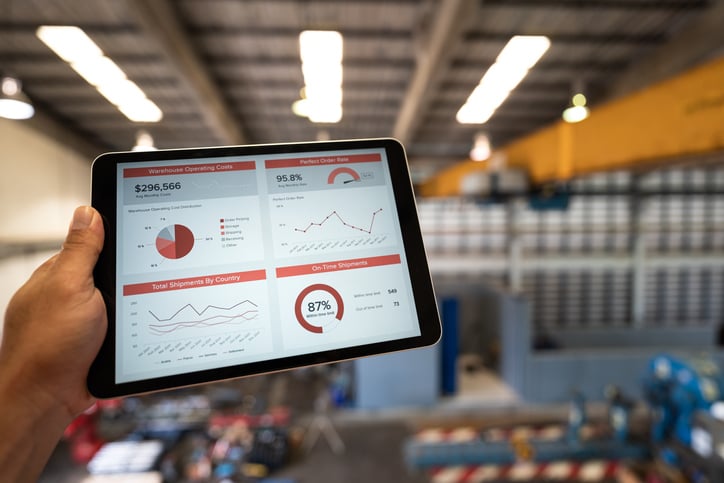
Imagine having a live, virtual representation of your production line that lets you observe, analyze, and predict potential issues several hours before they actually happen. In some cases, this advanced system may also simulate fixes to help you forecast their impact on production. While this all sounds ambitious, it is no longer a pipe dream.
Known as digital twins, these systems are emerging as one of the most effective ways to tap into complex operational data and gain practical, actionable intel from the factory floor. They are expanding rapidly across industries, with the global digital twin market projected to achieve a 47.9% CAGR from more than $21 billion in 2025 to almost $150 billion in 2030.
This technological shift is much needed in an age when companies are under constant pressure to produce faster at lower costs while managing volatile supply chains and shrinking manpower. Digital twins deliver exceptional value, helping manufacturers identify slowdowns or test fixes to achieve targets with minimal downtime. However, they come with an important caveat.
Like any other data-driven tool, digital twins also need clean and accurate frontline data to analyze and predict outcomes effectively. They follow the “garbage in-garbage out’ philosophy, needing context and clarity from daily operations before they can make prudent decisions. Without the right context, they may become static models that produce more noise than insight.
In this article, we’ll explain what a digital twin is and how it can become a reliable operational partner with strong frontline data.
What Is a Digital Twin in Manufacturing? Definition, Benefits, and Industry 4.0 Impact
Originally used for space exploration missions at NASA, the term “digital twin” was coined by Dr. Michael Grieves, an American scientist specializing in product life-cycle management (PLM).
The best way to understand a digital twin is to think of it as a mirror that continuously reflects all that’s happening on the production floor – only virtually. It goes one step further, parsing both live and historical data to predict problems and test fixes in a safe environment before implementing them on the shop floor.
As Siemens USA CEO Barbara Humpton explains in a CNBC interview, “(A) digital twin can help you play around with a whole lot of permutations before you start to bend metal – ask yourself, how would this perform, how would that perform.”
For example, the digital twin of a bottling plant may track everything from machine speeds to maintenance activity. If the output drops, the twin may help teams identify which step in production caused it, whether a material change or a worn component.
It may then simulate fixes virtually before recommending the best solution to prevent interruptions and downtime. Essentially, it takes the guesswork out of problem-solving and offers concrete solutions to help operations run smoothly. If used well, with precise data and context to feed it, it can help you:
- Reduce future maintenance expenses by providing preventive insights into potential product or equipment problems.
- Accelerate production cycle times by up to 30% on critical processes through simulated testing and optimization.
- Prevent product failures and market backlash by conducting thorough R&D before a launch.
- Manage supply chains and inventory more effectively with predictive stockout and material shortage alerts – much before they actually occur.
The Why Frontline Data Is Critical for Successful Digital Twin Deployment
Deploying a digital twin with unreliable data is like building on a shaky foundation. In such cases, insights from your digital twin can cause unplanned downtime that may cost you several thousand dollars per hour, especially if they involve faulty suggestions regarding heavy machinery.
The real gap lies with capturing key execution data, something even advanced enterprise resource planning (ERP) and manufacturing execution systems (MES) cannot do. For example, these systems are good at scheduling production timelines or tracking output. However, they tend to overlook more nuanced events on the shop floor, such as how an operator handled a deviation or what fixes they implemented during a material shortage.
Production teams may log such events much later, if at all. When such details fall through the cracks, a digital twin may start reflecting an idealized version of reality that doesn’t help the production line.
Additionally, valuable data and events occurring on the production floor often go unnoticed under the radar due to rigid and outdated systems. Many operators and technicians continue to use manual tools such as paper forms or spreadsheets that don’t actively capture events on the shop floor. Inconsistent and delayed data fail to feed digital twins the live context they need to make better decisions.
So, how can manufacturers capture frontline data more efficiently? A wise move is to invest in software that helps teams record real-time data. Some 80% of businesses reported that doing this helped increase revenue.
Close the Frontline Data Gap for Better Digital Twin Performance
Digital twins only perform as well as the data feeding them. Discover how structured, real-time frontline data capture improves simulation accuracy and reduces costly downtime.
Request a Data Gap ReviewHow Alpha Software Strengthens Digital Twin Systems
Alpha Software’s low-code functionalities enable manufacturers to build mobile apps and dashboards aligned with their daily workflows, so that production teams can easily capture high-quality data – the kind digital twins rely on – on the go.
For instance, if a quality issue hinders a production line, operators can quickly log the exact cause in the app or add an image of the affected machinery. When the digital twin detects this issue as it happens, it can generate “what-if” analyses and recommend the optimal fix to prevent lengthy downtime.
Over time, with consistently rich and reliable data, digital twins can make manufacturing workflows self-sufficient, where issues are identified before they arise, and the most effective measures are prioritized over others – helping your teams recover faster from disruptions.
While digital twins are remarkable at building the factories of the future, you still need a reliable partner like Alpha Software that supports this system. Talk to Us Today
Turn Your Digital Twin Strategy Into Measurable Results
Digital twins are powerful tools for building the factories of the future. But they depend on accurate, real-time execution data. Alpha Software enables manufacturers to capture structured shop floor data that strengthens digital twin performance and operational decision-making.
Talk to Our Experts








Comment