
 A few weeks ago I wrote about the importance of human insight and a question I keep coming back to:
As AI systems spread, does trustworthy human insight become even more valuable?
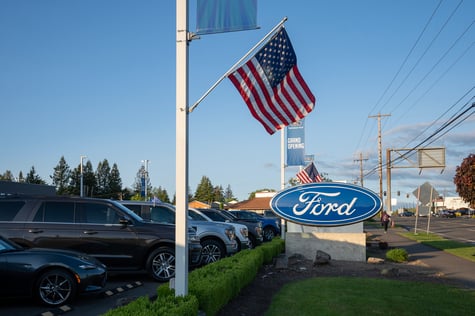
Ford just answered that question publicly, and it's been a painful lesson that the whole world should learn from.
On June 25, Ford topped J.D. Power's 2026 U.S. Initial Quality Study among mass-market brands. It's their best mainstream result in 16 years and the largest year-over-year improvement of any brand this cycle, trailing only Porsche and Genesis overall. The F-150, Mustang, and Super Duty each won their segments for the second year in a row. But that's only half the story.
Ford's 16-year High Has a Catch: Millions of Recalled Vehicles
On July 1, Ford recalled more than 741,000 vehicles, including F-150s, Explorers, Expeditions, and Lincoln Aviators and Navigators from model years 2018 through 2021, after finding a transmission defect that can let a parked vehicle roll away on its own. That follows a year of significant safety actions. As of July 28, Ford has recalled more than 13.5 million vehicles across 61 separate campaigns in 2026, so many that Ford alone accounts for more than half of every vehicle recalled by the entire U.S. auto industry this year. The campaigns have kept coming through July, including a fresh recall of roughly 80,000 Explorers and Aviators traced to a new seat-motor supplier and, tellingly, a recall issued to fix a previous recall.
Ford alone accounts for more than half of every vehicle recalled by the entire U.S. auto industry this year, with the manufacturer nowing issuing recalls to fix previous recalls.
It's worth sitting with both of those facts at once instead of picking whichever one fits the story you want to tell. J.D. Power's Initial Quality Study measures problems owners report in the first 90 days with a new vehicle. Recalls frequently trace back to older designs and decisions made years earlier, in some cases before Ford's correction effort even began. That means Ford's newer vehicles can genuinely be improving while the company is still working through a backlog of older engineering debt. Both things are true at the same time, and neither one cancels out the other.
Those are the headlines. The backstory, and what's happened since, provides a lesson manufacturing and operations leaders should really pay attention to.
Where Ford's Quality Problems Originate
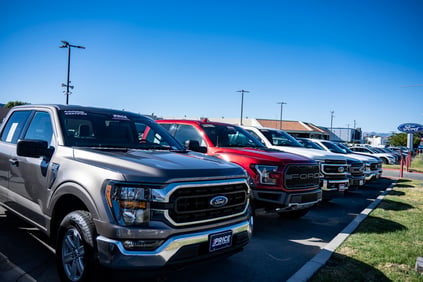 According to reporting from The Verge, Ford's VP of vehicle hardware engineering, Charles Poon, told reporters that the company had assumed introducing AI and automated systems and feeding them the existing design requirements would be enough on its own to produce a high-quality product. It wasn't.
Ford's recall problem isn't the AI itself. It's what the AI never got the chance to learn. A lot of Ford's most experienced engineers had already left the company before anyone captured their knowledge so the automated systems could use it. That's not information that shows up in a requirements document. It's the instinct a veteran engineer builds after decades of watching real vehicles fail in real conditions, the ability to sense a defect coming before it actually shows up.
When that expertise walked out the door, it didn't just leave a staffing gap. It left a data gap. The automated systems weren't trained to catch what they had never been shown, so they kept running and kept getting things wrong, with just as much confidence as if they'd been right.
The Fix Isn't Less AI -- It's More Grounded AI
The fix is reconnecting AI to a steady, validated stream of human judgment.
Ford didn't walk back its investment in automation. It added more than 100,000 new AI-powered software tests and stood up a dedicated quality assurance team. What changed was the other half of the equation. Starting in 2023, Ford hired, promoted, or brought back roughly 300 to 350 experienced engineers, specifically to run weekly design reviews, mentor junior staff, rebuild the data pipelines feeding its AI training, and refine the tools that were originally supposed to replace some of that expertise.
In other words, the fix was reconnecting the AI to a steady, validated stream of human judgment.
The Pattern is Bigger than One Automaker
We've written before about why AI-generated apps often fail once they hit real-world operations, where the demo works but the deployment doesn't, because the tool was never built to enforce or validate how data gets captured at the point of work. We've also written about why AI readiness is really a data readiness problem hiding behind an AI headline.
Ford's story is a version of the same thing, just at a much bigger scale and with a longer tail. Nike's recent FIFA shirt fiasco is another example.
An AI system is only as good as the real-world signal that's actually feeding it. When that signal, in this case decades of hard-won engineering judgment, quietly stops flowing in, the system doesn't fail loudly. It fails confidently. It keeps producing outputs; they just drift a little further from reality each time, and nobody notices until the problem shows up in a customer's driveway or in a recall notice years later.
It's the same dynamic we described as model collapse, or synthetic data drift, in our earlier post: AI systems gradually losing touch with reality as they lose access to authentic human observation. Ford's version wasn't caused by training on synthetic data. It was caused by losing the people who held that tacit knowledge before it was ever captured anywhere. Different mechanism, same lesson. The moment validated human insight stops feeding the system, the system starts drifting, and it won't tell you that's happening or how long it will take to work its way back out
The Takeaway for Every Operations Leader
Ford is one of the most sophisticated manufacturing and engineering organizations in the world, and it's still three years and hundreds of hires into correcting for this issue, with the recall numbers showing the fix hasn't fully caught up yet. That's worth thinking about, especially if your organization is earlier in this process than Ford was.
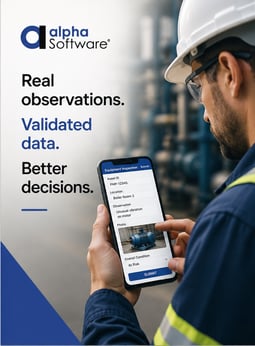
The organizations that get AI right in operations won't be the ones that use it the most. They'll be the ones who build the discipline to keep validated human observation flowing continuously into the system. They'll capture it at the point of work instead of piecing it back together after something breaks, and they'll plan for that now, not in a quarter or two.
Related reading:
The Achilles Heel of AI: Why Most AI Projects Fail (And How to Fix It)
Human insight keeps AI rooted in reality
Reduce Risk: Capture High-Value Human Signals at the Point of Work
Alpha Software solutions capture the high-value human signals at the point of work, before they walk out the door or die on a clipboard.
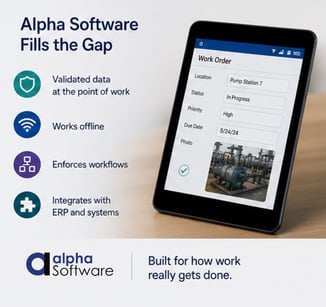 This is where Alpha Software fits. We don't build your AI models; we help make them more valuable and trusted. Our data collection apps capture that expert human signal at the point of work, before it walks out the door or dies on a clipboard. Alpha TransForm manufacturing solutions let your quality, inspection, and frontline teams turn the checks and reviews they already run into mobile apps in days, not the multi-year IT project you're bracing for. Our solutions capture photos, readings, and timestamps automatically, work offline anywhere on the line or in the field, and feed structured, validated, attributable data straight into the systems that your AI depends on. Our solutions are the difference between a model leveraging what your best people actually observe and a model confidently guessing because that observation was never recorded.
Ford is still paying for the absence of that discipline—capturing human judgment at the point of work and keeping it flowing continuously.
If your organization is exploring AI intiatives, ERP modernization or improving operational data quality don't make the same mistake as Ford. Take the AI-Readiness Assessment or Let's talk.
Author Amy Groden wrote further about the lessons Ford learned about AI on LinkedIn.
Further reading:








Comment