
I've written a lot this year about what happens when operational records can't answer the question being asked of them, most recently in The $462 Million Question about whether inspection records survive discovery.
This summer's cyclospora outbreak is that question again, in a different industry, on a national scale, and in real time.
An Food Quality Issue That's Hard to Trace
 As of the CDC's July 22 update, more than 11,500 confirmed and suspected cases of cyclosporiasis have been reported across 41 states since May 1. That includes 4,173 laboratory-confirmed cases and 308 hospitalizations, with roughly 7,400 additional cases still awaiting confirmation, most of them in Michigan and Ohio. Confirmed cases alone have already passed the 3,955 reported in all of 2025. CDC assumes a six-week lag between illness onset and reporting, so the count is expected to keep climbing. No deaths have been reported.
A subset of those illnesses — a nine-state cluster across Illinois, Indiana, Kansas, Kentucky, Michigan, Ohio, Oklahoma, Pennsylvania, and West Virginia — was traced to shredded iceberg lettuce served at Taco Bell locations. On July 17, Taylor Farms de Mexico voluntarily recalled all iceberg lettuce sourced from central Mexico. That product had been distributed to foodservice and retail customers in 27 states between June 29 and July 16.
The Hurtful Impact of a Wide Recall
 Here is the detail every operations leader in food and beverage should sit with.
According to Taylor Farms' own public statement, FDA's traceback pointed to a specific independent farm — one representing less than 1% of the U.S. iceberg lettuce supply. And the resulting action was the removal of all iceberg lettuce sourced from an entire region of Mexico, across 27 states, for the remainder of the growing season.
That gap between the size of the suspected problem and the size of the response is not carelessness. It is what happens when the available data can't support a more precise answer. When you cannot isolate the lot, you pull the region. When you cannot prove which pallets are implicated, every pallet is implicated.
When you cannot isolate the lot, you must pull the entire region.
The financial consequences of that imprecision are enormous, and they land on a company that may well have done everything right at the processing facility. An entire season's sourcing from a growing region was withdrawn because they couldn't trace the problem down to the lot level — only to the region. Better data may have avoided this wider recall.
Further Reading: What Ford's Quality Turnaround (and Recent Recalls) Tells Us About AI and Human Judgment
Understanding The Food Traceability Rule
 FSMA Section 204 — the Food Traceability Rule — was written for exactly this situation. It requires companies handling foods on the Food Traceability List, leafy greens very much included, to record Key Data Elements at each Critical Tracking Event: lot codes, quantities, source locations, and dates, with traceability lot codes assigned at each transformation. The rule requires those records to be delivered to the FDA in a standardized electronic format within 24 hours of a request.
The rule's original compliance date was January 20, 2026.
However, in March 2025, the FDA announced its intention to extend that date by 30 months. The extension was published in the Federal Register that August, and in November 2025 Congress made it binding, directing FDA not to enforce the rule before July 20, 2028.
These cyclosporiasis illnesses began in May 2026. Which places this outbreak squarely inside the deferral window — arguably the first major leafy-green outbreak to run its entire course in the gap between the rule that was written and the rule that is enforced.
Food safety attorney Bill Marler, whose firm filed suit in the Eastern District of Michigan on July 20, put the operational reality of that gap bluntly: investigators spent roughly two months doing by hand what the rule was designed to do automatically. Two months, during which the product kept moving and people kept getting sick.
The 2028 deadline is not a reprieve. It is the amount of runway you have left.
Further reading: Product Traceability and Recalls: The High Cost of Doing Nothing
Three Reasons Why Food Manufacturers Don't Have Until 2028
The most common response to a compliance deferral is to move the project to the back of the roadmap and focus on other priorities. That reasoning made sense in March 2025, but it does not survive this summer for food manufacturing leaders, for three reasons:
-
Your customers already moved. Walmart's supplier traceability requirement (advance shipping notices carrying KDE data, SSCC-18 pallet labels, and GS1-128 case labels) took effect August 1, 2025. Chargebacks for non-compliant shipments are being assessed right now. For a great many suppliers, the retailer mandate arrived nearly three years before the federal one, and it holds vendors accountable monthly rather than eventually.
-
The plaintiffs' bar did not wait. Lawsuits were filed within days of the recall: Ayyad v. Pacific Bells in federal court in Ohio and Hercula v. Taco Bell of America in the Eastern District of Michigan, with more coming. These cases proceed on strict product liability, negligence, breach of warranty, and consumer protection theories. None of them require a federal finding, or a positive product test, or a completed investigation. They require medical records, lab results, expert testimony, and traceback data. As I wrote my surviving discovery piece, the courtroom will not grant extensions just because the regulator did.
-
You will be asked to prove things in public, under pressure, before you are ready. This outbreak featured a positive product test, a retraction of that test, competing public accounts of what was said between an agency and a company, and a week of national confusion about what consumers should actually do. The details remain disputed, and the investigation continues. The transferable lesson is narrower and applies to everyone: when your data cannot affirmatively answer the question, the only remaining move is to argue about the other side's evidence. That is a weak position, and it appears weak to regulators, customers, and the public. Companies with granular, timestamped, defensible lot-level records have a better option available. They can simply show the data.
Customer requirements, lawsuits and public scrutiny will not wait until 2028 for better traceability reporting.
Where Digitization of Records Helps
 Digital inspection and quality records would not have prevented cyclospora contamination. The parasite enters through the field: irrigation water, soil, or contamination upstream of any processing plant. No app on a tablet can stop that. Any vendor telling you otherwise is selling you something.
However, what better data changes does help with is everything downstream of a contamination scenario. Better data can:
- Accelerate traceback time. Weeks of manual reconstruction are compressed into a single query.
- Reduce the scope of recall. Lot-level resolution turns a region-wide, season-long withdrawal into a targeted removal of implicated lots.
- Increase defensibility. Records captured at the point of work (timestamped, geotagged, attributed, photo-backed) establish what was inspected, by whom, and when, without relying on reconstruction from memory.
- Speed delivery of proof. FSMA 204 allows 24 hours to hand the FDA your traceability records once they're requested. The challenge isn't storing the records, it's being able to assemble them across your whole supply chain immediately. Building a system that can do that isn't a quick fix and mustn't be a scramble the day of the deadline.
That last point deserves emphasis. Teams that treat traceability as a filing exercise discover, usually at the worst moment, that the data exists but cannot be assembled. The work of connecting HACCP monitoring, receiving inspections, and quality control records into something queryable is not a compliance sprint. It is an operating change, and it runs on a multi-year clock.
Teams that treat traceability as a filing exercise discover, usually at the worst moment, that the data exists but cannot be assembled.
The Painful Cost of Status Quo
Here is the uncomfortable structure of this decision, and it is not unique to food and beverage.
Choosing to keep the current process always looks free. There is no invoice for the status quo, no line item, no implementation risk, no change management. The cost of deferring shows up nowhere on a budget, right up until the week it shows up all at once as an entire growing region withdrawn, a docket of federal lawsuits, and a national news cycle you do not control.
Meanwhile, the cost of acting is fully visible, fully priced, and easy to defer to the next quarter and push to every quarter after that.
Regulatory deadlines exist partly to break that asymmetry. They convert an invisible risk into a visible date. When the date moves, the risk remains unchanged; it just goes back to being invisible. That is precisely what the last eighteen months have done to traceability across this industry, and this summer is what the cost of inaction looks like.
Further reading: The $462 Million Question: Could Your Inspection Records Survive Discovery?
Make the Move Before 2028: Get FSMA 204-Ready Without the Multi-Year Project
 This is where Alpha Software comes in and how we help food and beverage companies. We fix everything downstream of it: the paper binders, the spreadsheets, and the "it's in someone's inbox" records that turn a 24-hour FDA request into a two-week scramble.
Alpha TransForm lets your quality and operations teams turn the inspection, receiving, and lot-tracking forms you already use into digital solutions in days, not the multi-year IT project you are bracing for. Our mobile apps map exactly to your workers' daily workflow. Our apps work offline on any mobile device in the plant or the field, capture photos, barcodes, and timestamps automatically. They feed into your existing systems or new dashboards so the record is structured, attributed, and instantly searchable or shareable the moment you need it. Alpha Software solutions are the difference between reconstructing what happened and simply showing it. Because our consultants are domain experts and use no-code or rapid app development, your tailored solution can be on your floor or in your field for testing in days. This means the people who own the process at your organization can have new apps, dashboards, and reports live and collecting defensible data before your next audit.
Alpha Software solutions are the difference between reconstructing what happened and simply showing it. The people who own the process at your organization can have new apps, dashboards and reports live and collecting defensible data before your next audit.
The 2028 deadline is not a reprieve. It is the amount of runway you have left.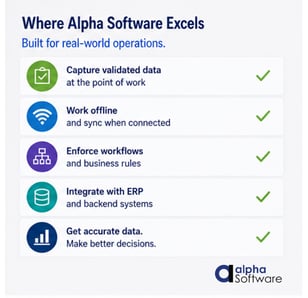
Your team can have new tailored apps and dashboards that match your process live and collecting defensible data before your next audit. If your team is working through FSMA 204 readiness, recall preparedness, or moving quality and inspection records off paper, schedule a 10-minute call and let's talk.
Further reading: The Importance of Operational Data Integrity | Food Industry Inspection Checklist: Templates & Examples








Comment