
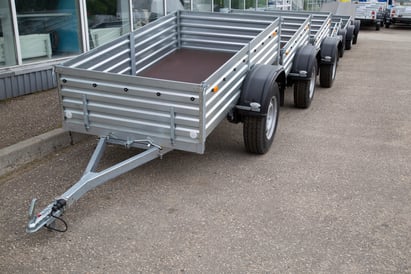
 In May, the U.S. Supreme Court did something that should concern every manufacturer, even though the case wasn't about manufacturing. In Montgomery v. Caribe Transport II, the Court ruled unanimously that federal law does not shield freight brokers from state negligence claims when they place loads with unsafe carriers, overturning years of circuit precedent. Brokers are middlemen. They don't design equipment, build it, or maintain it. Their entire defense now rests on documentation: whether they can show how they vetted the carriers they hired.
If the middlemen are exposed, manufacturers were there first. In 2024, a Missouri jury handed down one of the largest verdicts in trucking industry history: $462 million against trailer manufacturer Wabash National, following a fatal rear underride crash. The punitive portion was later reduced and the case settled, but the number itself reverberated through every manufacturer, fleet operator, and supplier in the transportation sector. The circle of liability in this industry is expanding, not shrinking.
The scale of exposure is enormous. According to the National Safety Council, more than 5,200 large trucks were involved in fatal crashes in 2024—roughly 9% of all vehicles involved in fatal crashes—a figure that has climbed 30% over the past decade. Another 120,000+ large trucks were involved in injury crashes in 2024 alone, up more than 5% year over year. Every one of those incidents is a potential lawsuit. And every lawsuit begins in the same place.
Litigation is Won or Lost in Discovery
Here's what most operational leaders underestimate: long before a jury hears opening arguments, the plaintiff's attorneys will subpoena your records, years of them. This includes inspection logs, maintenance histories, testing data, complaint files, corrective-action documentation, and internal communications about known issues.
 The attorney's playbook is straightforward:
-
Identify the gaps. A missing inspection record doesn't read to a jury as "paperwork got lost"; it reads as "the inspection never happened" or worse, "the company destroyed evidence."
-
Uncover the inconsistencies. A paper form dated after the fact, a checklist filled out in identical handwriting for 40 units, or a maintenance log that contradicts a work order hands opposing counsel a credibility weapon.
-
Turn disorganization into a narrative. Fragmented records scattered across paper binders, spreadsheets, and email inboxes take months and enormous legal fees to produce. Sloppy production makes even a diligent company look negligent — and juries punish companies that look like they don't take safety seriously. Legal analysts point to exactly this dynamic as a driver of today's "nuclear verdict" era, in which eight- and nine-figure awards against transportation companies have become routine.
The hard truth: you can do the work and still lose the argument if you can't prove the work was completed. In a courtroom, an inspection that isn't documented completely, contemporaneously, and verifiably may as well not have happened.
What a discovery-ready record looks like
Companies that fare best under legal scrutiny share a common trait: their safety data is captured digitally, at the point of work, in a form that is complete, timestamped, and tamper-evident. That means:
-
Structured digital inspection forms that ensure users cannot skip required fields make every record complete by design: no blank boxes for opposing counsel to circle in red.
-
Automatic timestamps, GPS location, and user identification on every entry establish exactly who performed the inspection, where, and when. Backdating becomes impossible; credibility becomes provable.
-
Photo and rich-media capture are built into the workflow, so the record doesn't just say a weld was inspected; it shows the weld, attached to the inspection, at the moment of inspection.
-
Offline-capable mobile capture for shop floors, yards, and roadside checks, so documentation happens in real time rather than being reconstructed from memory at a desk hours later. (Reconstructed records are a favorite target on cross-examination.)
-
Centralized, searchable, auditable storage with a clear chain of custody. When a subpoena arrives, complete production takes days, not months, and your legal team is prepared instead of scrambling.
-
Ensure trend visibility and implement closed-loop corrective action so that your team flags, addresses, and documents emerging issues before they escalate into incidents. The best litigation strategy is the incident that never occurs; the second best is a paper trail showing you identified and resolved problems promptly.
This issue is the gap that modern mobile data-collection solutions, like those from Alpha Software, are designed to fill. Our solutions replace paper checklists and disconnected spreadsheets with digital inspection and maintenance workflows that create defensible records as a byproduct of everyday operations. Our customers no longer put the extra burden on technicians and no longer rely on end-of-shift memory.
The cost equation has flipped
 A decade ago, digitizing inspection and maintenance documentation was a nice-to-have efficiency project. Compare the cost of a modern data-collection solution against a single 7-figure legal defense, and the decision seems simple. Now imagine a nuclear verdict amplified by documentation gaps, and you can't move fast enough to shore up your data collection gaps.
The Supreme Court's broker-liability ruling and the Wabash verdict indicate that courts, juries, and plaintiffs' attorneys are holding everyone in the transportation chain to a higher standard of proof. The companies that thrive in this environment won't just be the ones doing the right things on the shop floor. They'll be the ones who can prove it instantly, completely, and beyond dispute.
Can your records survive discovery? If you're not certain, we can help.
Further reading:







Comment