
 AI has changed how quickly applications can be built. AI tools are designed to help build applications, but businesses don’t need more apps. They need systems that operate reliably under real-world conditions, across teams, environments, and edge cases.
With the rise of AI-powered tools and “vibe coding,” teams can now generate working apps, forms, and workflows in minutes. For many organizations, this feels like a breakthrough.
And it is.
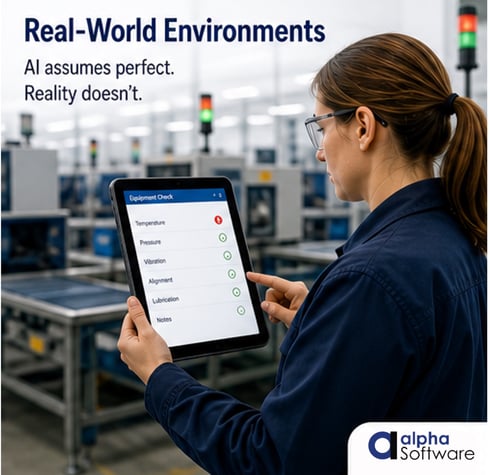 But there’s a problem that becomes clear the moment those apps leave the screen and enter real-world operations:
Many AI-generated apps don’t hold up under real-world conditions.
Why AI-Generated Apps Look So Promising at First
AI tools are incredibly effective at:
- Generating user interfaces
- Creating simple workflows
- Connecting APIs at a basic level
- Accelerating early-stage development
In fact, according to Stack Overflow surveys, the majority of developers now use AI tools in their workflow.
For prototyping and experimentation, AI is a major advantage.
But building something quickly is not the same as building something that works reliably at scale.
Where AI-Generated Apps Break Down
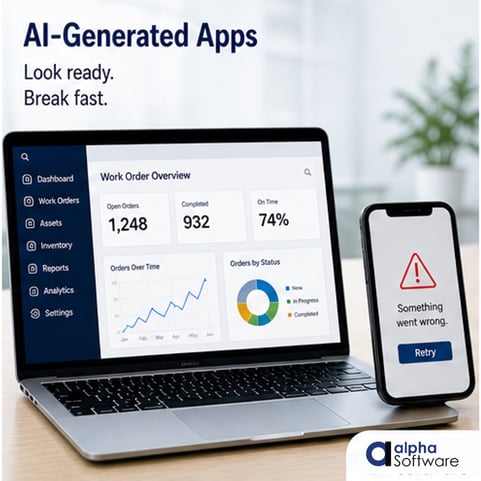 The gap shows up in real-world environments, not in TikTok videos or cool demos.
1. No Offline Capability
Most AI-generated apps assume a stable internet connection, but often employees operate in warehouses, shop floors, docks or field locations where no signal is available.
When apps depend on constant connectivity:
-
data capture is interrupted
-
workflows break
-
users revert to manual processes.
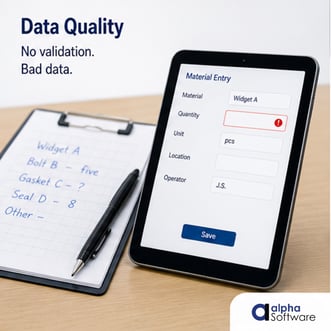
2. Weak Data Validation
AI can generate forms, but it doesn’t enforce how employees should capture data. That leads to:
-
inconsistent inputs
-
missing data
-
incorrect entries.
If your app collects bad data, everything downstream breaks.
According to Gartner, poor data quality costs organizations an average of $12.9 million per year.
Read why operational data integrity is so critical to organizations today.
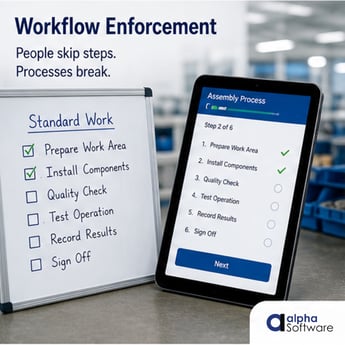
3. Inconsistent Workflows
AI-generated apps don’t enforce process consistency.
In real-world operations:
-
steps get skipped
-
processes vary by user
-
outcomes become unpredictable
Missed steps or inconsistences create operational risk, especially in quality, safety, and compliance environments.
4. Fragile Integrations

AI tools can connect to systems at a surface level, but real-world integrations require:
-
reliable data synchronization
-
structured data formats
-
error handling
-
ongoing maintenance.
Without these, integrations become fragile and unreliable.
5. No Audit Trail or Compliance Structure
In many industries, it’s not enough to collect data. Highly regulated industries must prove:
-
when work was completed
-
who completed it
-
how it was validated.
AI-generated apps rarely provide this out of the box. This is why manufacturing AI readiness depends less on the AI model itself and more on whether operational workflows capture validated, audit-ready data at the point of work.
Makebot research shows that up to 85% of AI failures are linked to poor data quality or data readiness issues.
 The Real Problem: AI Builds Apps, Not Operational Systems
AI tools are designed to help build applications, but more apps aren't helpful if they can't:
-
reflect real workflows
-
enforce process consistency
-
capture accurate data
-
integrate into existing operations.
Companies need apps that work under real-world conditions and improve the data they're using across the organization and for AI models. This is where companies can run into trouble. This isn’t just a technical issue; it’s becoming a widespread operational problem.
Why This Problem Is Getting Worse
 AI is lowering the barrier to building apps. More citizen developers and trying their hand at vibe coding to solve business problems.
That means:
-
more apps are being created
-
more teams are experimenting
-
more workflows are digitized.
But without a strong foundation for data and execution, this leads to:
-
more inconsistent processes
-
more unreliable data
-
more operational risk
This is the same issue we see across AI initiatives. Why data quality is the Achilles' heel of AI becomes even more obvious as these systems scale.
AI doesn’t eliminate these problems. It scales them.
How to Build Apps That Actually Work in Real-World Operations
To move from a working demo to a working system, apps must be designed for execution.
That includes:
-
Offline-first capability
-
Data validation at the point of entry
-
Guided workflows
-
Reliable integration with backend systems
-
Audit-ready data capture
 Where Alpha Software Fits
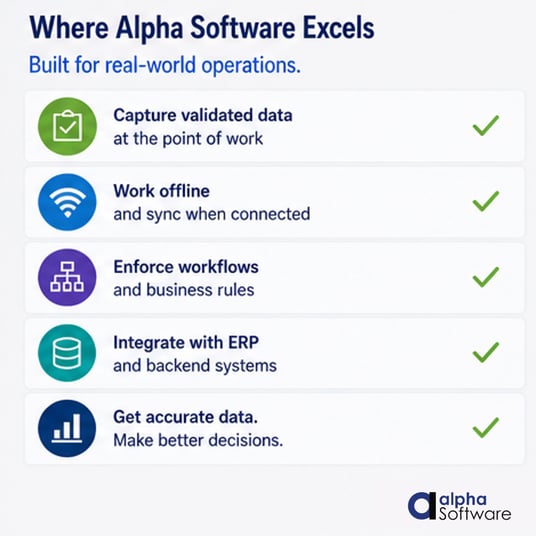
This is exactly where most AI tools fall short and where Alpha Software is designed to operate. Instead of generating generic apps, Alpha Software helps build solutions that match how your business actually operates.
Alpha TransForm custom solutions are tailored to your business and can:
-
operate fully offline when needed
-
enforce workflows in real time
-
integrate directly with ERP and backend systems
The Bottom Line
AI has made it easier than ever to build apps, but building them isn’t the hard part. Making them work in real-world operations is.
The organizations that succeed with AI won’t be the ones that build the fastest. They’ll be the ones that build systems that work.
 Alpha Software Builds Apps that World in the Real World
If you’re experimenting with AI-generated apps but unsure whether they’ll actually work in your operation, you’re asking the right question.
Book a meeting with Alpha Software and we’ll turn your workflow into a production-ready solution that works in real-world conditions.
Frequently Asked Questions About AI-Generated Apps
Why do AI-generated apps fail in real-world operations?
What are the biggest limitations of AI app builders?
- No offline functionality
- Weak data validation
- Inconsistent workflows
- Fragile system integrations
- Lack of audit trails and compliance support
Can AI build production-ready business applications?
What is the difference between AI-generated apps and operational business systems?
How can companies make AI-generated apps more reliable?
- Implement data validation at the point of entry
- Design structured workflows
- Ensure offline capability
- Integrate with existing systems
- Capture audit-ready data









Comment