
AI tools have made it easier than ever to build applications. Searches for “best AI app builders” are growing rapidly, but most lists miss what actually matters.
Today, you can generate apps, workflows, and dashboards in minutes using AI-powered platforms. For many teams, these tools enable faster development and lower costs. However, there is a gap that most lists of the best AI app builders do not address:
Building an app is not the same as running a business.
This guide covers the most popular AI app builders and where they fall short when used in real-world operations.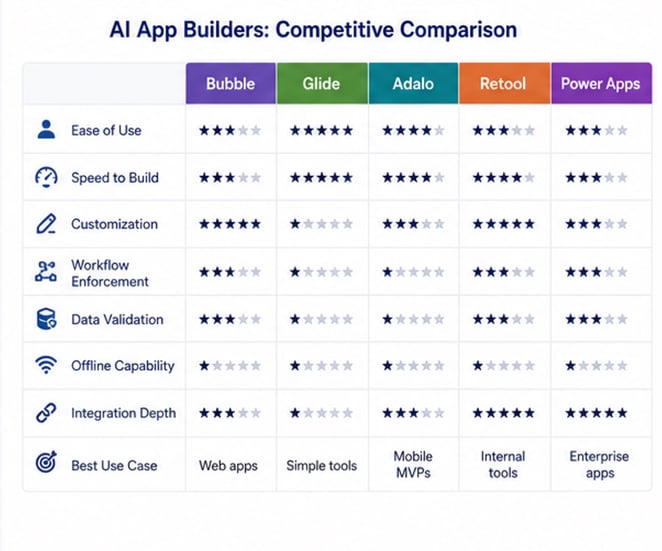
What to Look for in an AI App Builder
Before jumping into tools, it’s important to define what actually matters.
Most AI app builders are evaluated based on:
-
ease of use
-
speed of development
-
UI generation
But for business applications, you also need:
-
offline capability
-
data validation
-
workflow enforcement
-
system integration
-
auditability
This is where many tools fall short.
The Best AI App Builders Right Now
These tools are often listed as the “best AI app builders,” but they are optimized for speed and ease of development, not necessarily for real-world business execution.
1. Bubble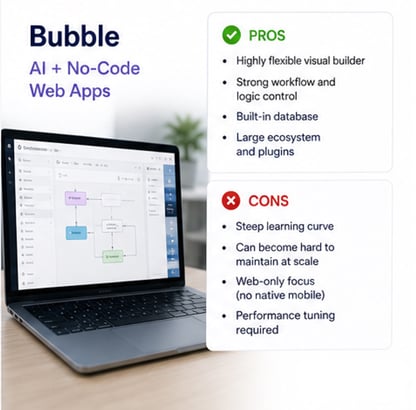
Best for: No-code web applications
Bubble allows users to build web apps using a visual interface, and it has begun integrating AI features for faster development.
Strengths:
- Flexible UI builder
- Large ecosystem
- No-code friendly
Limitations:
- Limited offline capability
- Requires workarounds for complex workflows
- Can become difficult to maintain at scale
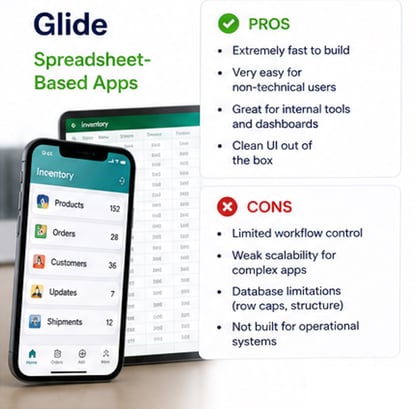 2. Glide
Best for: Simple internal tools
Glide turns spreadsheets into apps and has added AI features to streamline app creation.
Strengths:
- Extremely easy to use
- Fast setup
- Good for internal dashboards
Limitations:
- Limited workflow control
- Not built for complex operational processes
- Weak integration depth
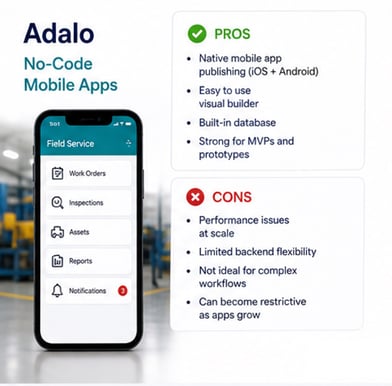 3. Adalo
Best for: Mobile app prototyping
Adalo allows users to create mobile apps with drag-and-drop tools and some AI-assisted features.
Strengths:
- Mobile-first approach
- Visual builder
- Fast prototyping
Limitations:
- Performance issues at scale
- Limited backend flexibility
- Not ideal for operational workflows
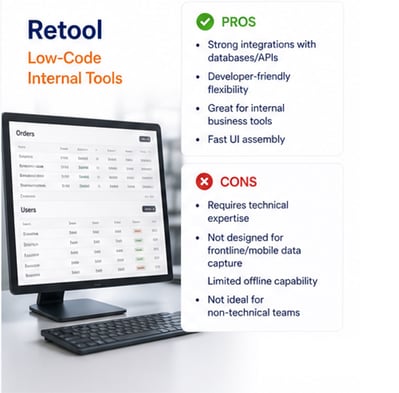 4. Retool
Best for: Internal business tools
Retool combines low-code development with AI-assisted features for building internal apps.
Strengths:
- Strong integrations
- Developer-friendly
- Flexible UI
Limitations:
- Requires technical expertise
- Not designed for frontline data collection
- Limited offline capability
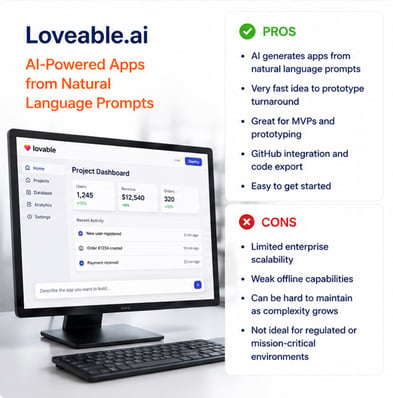 5. Loveable.ai
Best for: AI-generated MVPs and rapid prototyping
Loveable.ai uses natural language prompts to quickly generate web applications, workflows, and interfaces.
Strengths:
-
Fast AI-generated app creation
-
Simple prompt-based workflow
-
Good for prototypes and MVPs
-
GitHub integration and code export
Limitations:
-
Limited enterprise scalability
-
Weak offline capabilities
-
Can become difficult to maintain as complexity grows
-
Not ideal for highly regulated operational environments
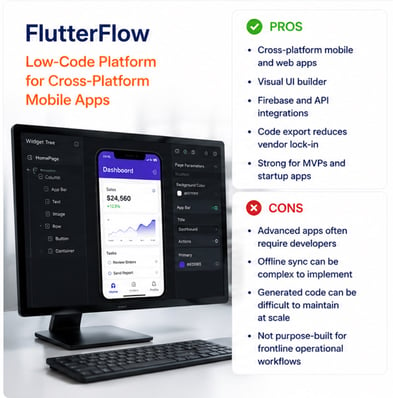 6. FlutterFlow
Best for: Cross-platform mobile app development
FlutterFlow is a low-code builder based on Google Flutter that helps teams visually create mobile and web apps.
Strengths:
-
Cross-platform mobile deployment
-
Visual UI builder
-
Firebase and API integrations
-
Code export reduces vendor lock-in
Limitations:
-
Advanced apps often require developers
-
Offline synchronization can become complex
-
Generated code can be difficult to maintain at scale
-
Not purpose-built for frontline operational workflows
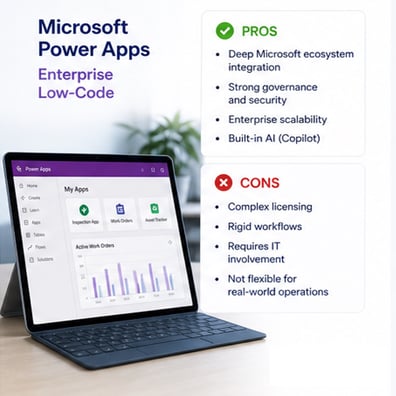 7. Microsoft Power Apps
Best for: Enterprise environments
Power Apps integrates with the Microsoft ecosystem and includes AI capabilities.
Strengths:
- Deep integration with Microsoft tools
- Enterprise scalability
- Strong governance
Limitations:
- Complex licensing
- Rigid workflows
- Limited flexibility for real-world processes
Read about the hidden costs of Microsoft PowerApps.
- Alpha TransForm
Best for: Operational mobile apps and frontline data collection
 7. Alpha TransForm
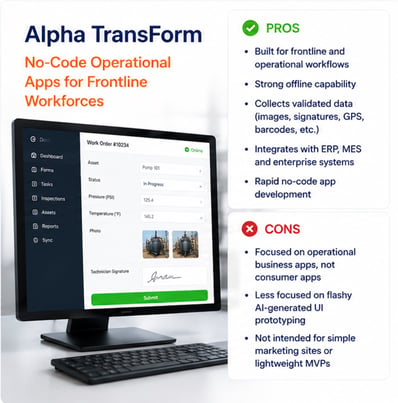
Alpha TransForm is a no-code app platform designed for companies that need to collect validated operational data from workers in the field, on the plant floor, or in remote environments. It not only crafts apps with AI capabilities, but also powers AI models with rich data collection for accurate, timely, and trusted data.
Strengths:
-
Strong offline capabilities
-
Built for frontline operational workflows
-
Rapid custom app development
-
Supports complex forms, workflows, photos, signatures, GPS, and barcode scanning
-
Designed for ERP/MES integration
-
Focused on validated, trusted data collection
Limitations:
-
More focused on operational business apps than consumer apps
-
Less focused on flashy AI-generated UI prototyping
-
Not intended primarily for simple marketing websites or lightweight startup MVPs
- Requires process planning for complex enterprise deployments
There are many other "best AI tools” lists out there, but these are ones I've seen people deploying most often. There are some great app builders in here that will work in many cases, but let's dive further into what really sets these solutions apart: testing in real-world operations. Deploying these in real companies introduces a whole new set of challenges and expectations, and not all AI or AI-assisted app builders can handle the work.
Where AI App Builders Fall Short
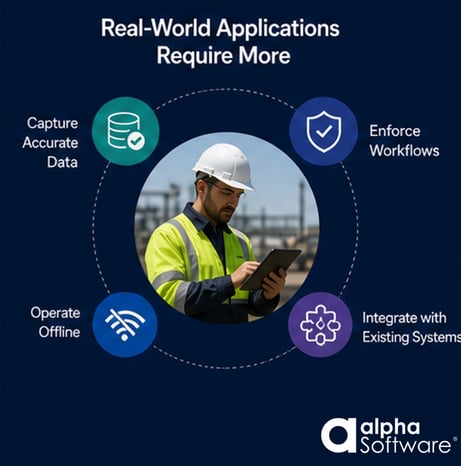 These challenges are not theoretical. They show up quickly in real environments. In fact, why AI-generated apps fail in real-world operations becomes clear as soon as teams try to scale them.
1. Real-World Environments
Most tools assume:
- stable connectivity
- consistent usage
- controlled environments
Real operations don’t work that way.
2. Data Quality
AI builders focus on generating apps, not on validating data.
According to Gartner, poor data quality costs organizations an average of $12.9 million per year.
Without validation at the point of entry:
- data becomes unreliable
- decisions suffer

 3. Workflow Enforcement
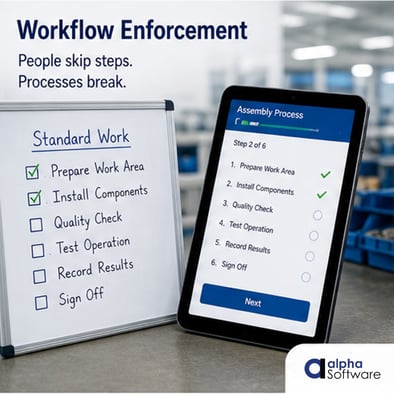
In real operations:
- steps must be followed
- processes must be consistent
Most tools don’t enforce this.
4. Offline Capability
Many business environments require apps to work without internet access.
Most AI builders:
- don’t support full offline operation
- or require complex workarounds
5. Integration Depth
Connecting to systems is one thing.
Maintaining reliable, structured integration over time is another.
The Real Difference: Apps vs Operational Systems
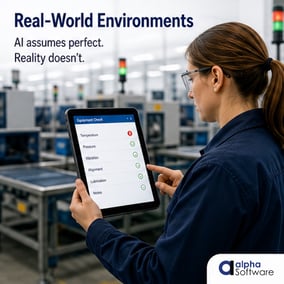 This is where most AI app builders reach their limits and where platforms designed for real-world operations come in. AI app builders help you create apps, but businesses need AI app development that works in real-world operations. Successful enterprise apps must:
- operate reliably
- capture accurate data
- reflect real workflows
- integrate into existing processes
That’s a different problem.
How to Choose the Right Approach
If you're trying to build applications that actually work in business environments, it's critical to understand what that requires.
Use AI app builders when:
- you need to prototype quickly
- you’re building simple tools
- speed matters more than reliability
Look beyond AI builders when:
- the app supports real operations
- data accuracy matters
- workflows must be enforced
- systems must integrate
Where Alpha Software Fits
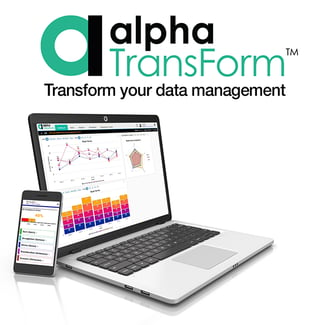
So how does Alpha Software stand apart? While you can use AI app builders to prototype apps, our technology takes those models and prepares them for real business operations environments. Our Alpha TransForm solutions deliver applications that:
-
capture validated data at the point of work
-
operate fully offline
-
enforce workflows
-
integrate with ERP and backend systems
Instead of just building apps, Alpha Software helps deliver systems that work in real-world operations.
What About Platforms Built for Real-World Operations?
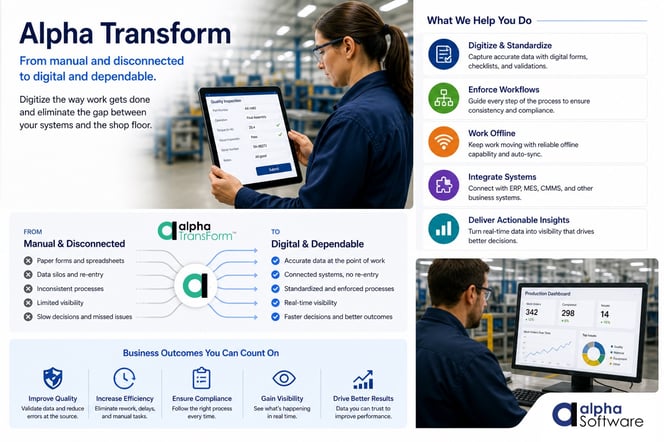
While many AI app builders focus on speed and ease of development, some platforms specifically support real-world business execution. The Alpha TransForm no-code app builder isn’t designed to replace AI app builders. It’s designed to take what those tools start—and turn it into a production-ready system.
 Alpha TransForm (by Alpha Software)
Best for: Operational business applications and real-world workflows
Alpha TransForm is not an AI app generator. It's an app builder designed to build applications that work reliably in real-world environments. Apps can be built from scratch, or you can prototype an app in an AI builder and use Alpha TransForm to turn it into a production-ready system for data collection, analysis, and reporting. Licenses are available, or our team can build the app for you so you can stay focused on your daily activities.
Strengths:
- Offline-first mobile capability
- Data validation at the point of entry
- Guided workflows that enforce process consistency
- Integration with ERP and backend systems
- Highly flexible, easily updated
How it’s different:
Rather than focusing on generating apps quickly, Alpha TransForm solutions match how your employees work under real-world conditions, with attention on data accuracy and validation, workflow consistency, offline operation, and system integration.
How to Evaluate AI App Builders for Real-World Use
 AI app builders are powerful tools.
But they’re not a complete solution for business operations.
The organizations that succeed will use these tools for speed while ensuring their systems are designed for reliability.
If you're comparing AI app builders and wondering which one will actually work in your business, you're asking the right question.
Book a meeting with Alpha Software and we’ll help you build a solution that works in real-world operations, not just in a demo.









Comment