Alpha Software Blog


Will AI Replace Developers? The "Last Mile" Enterprise Reality

AI gets you 80% of the way there, but the "last mile" (integration, offline capability, security) requires developers.

I've been reading posts in Linkedin and Reddit lately, and many developers are struggling right now.
The Value of Developers in an AI WorldIf you spend any time in communities like Reddit or Upwork, you’ll see the anxiety firsthand. Companies are asking if AI can replace developers entirely. Freelancers are watching low-end work disappear. Junior developers are wondering what happens next. 

The truth is more complicated.

AI is Adding Serious Speed to App Development

Undoubtedly, AI is changing software development forever. To be honest, some of that change is overdue. AI is incredibly good at routine and lower-level work like:

  • Rapid prototyping
  • Boilerplate generation
  • UI scaffolding
  • Basic CRUD apps
  • Helping small teams move faster

Where AI Apps Fall Short
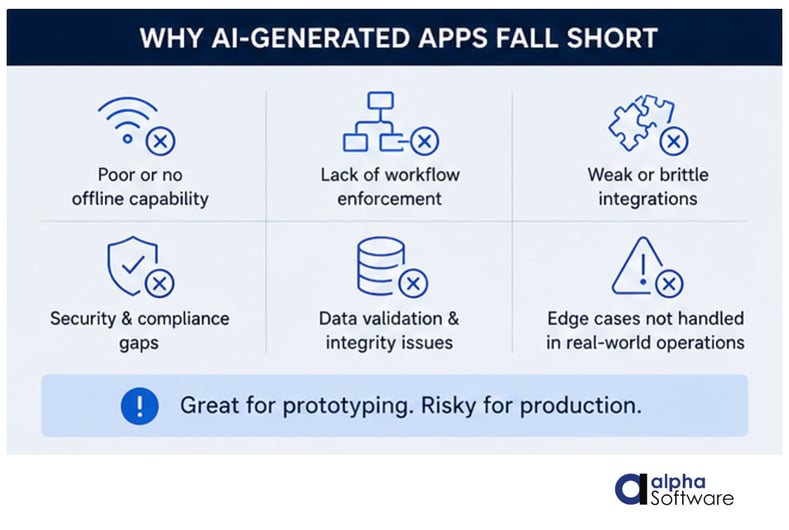
What AI apps lack for enterprise scenariosAI apps can have real value to startups and understaffed or underfunded teams that want to move faster. However, true enterprise software has always been more than generating screens and forms. The real hard part starts after the demo works and testing begins. That's where many AI-generated apps fail:

  • Complex integrations
  • Real-world workflow enforcement
  • Security and governance
  • Offline operation
  • Data validation
  • Reliability under messy operational conditions
  • Scalability across departments and processes
  • Handling edge cases that only appear in production

In other words: AI apps regularly fail in the final mile. The final mile is where experienced developers still matter enormously.

Why Developers Still Matter

Enterprises don’t just need apps, they need trusted operational systems that are intelligent about how business gets done.

A field inspection app has to work in a remote oilfield where no signal will be available. A manufacturing workflow must prevent inaccurate or incomplete data from entering ERP systems. A service technician app has to sync to the system of record correctly after hours offline. Compliance workflows require audit trails. Integrations need to survive system updates. This work still requires humans who deeply understand systems, architecture, operations, and business reality.

AI is becoming an incredible force multiplier for talented developers, but it’s not replacing the need for human and engineering judgment any time soon.

Combine AI Productivity with Enterprise App Development Experience
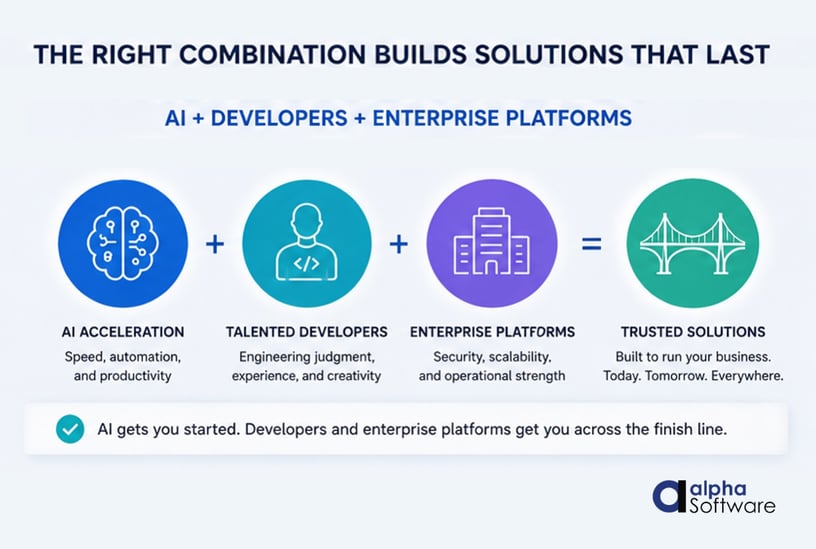
Combine AI, Developers and Enterprise Ready Platforms for real-world successThe companies that succeed won’t be the ones blindly replacing developers with AI.

They’ll be the ones combining:

  • AI acceleration
  • Strong development talent
  • Real operational understanding
  • Enterprise-grade platforms

AI can help build with the first 60-80%.

Experienced developers still deliver the last 20-40% that enterprises actually depend on.

And in enterprise software, that final 20% is usually the hardest part.

Learn How to Combine AI and Experienced App Development for Real-World Apps that Succeed

AI offers exceptional productivity, but operational software must work in the real world.

If your organization is exploring AI-generated apps, make sure you’re also thinking about the realities of integration, offline operation, workflow enforcement, and trusted data capture.

Talk to our app experts about how to gain efficiencies from AI while ensuring your applications truly deliver for the organization.



FAQs

Will AI replace software developers in enterprise environments?
Not in the foreseeable future, and especially not for the work that matters most. AI can get an application to roughly 70-80% completion quickly — generating UI components, basic workflows, and initial data connections. The remaining 20-30% is where developers earn their value: integrating with complex legacy systems, handling edge cases specific to that business's processes, building offline capability, enforcing security policies, and making sure the app behaves correctly when things go wrong. That last mile is where AI still consistently struggles.
What specifically can AI app builders not do well in enterprise settings?
AI tools hit their limits when applications need to work reliably without internet connectivity, synchronize data bidirectionally with ERP systems like SAP or Oracle, enforce compliance-grade audit trails, implement role-based security across large user populations, or handle the edge cases and exception flows that only emerge once real users are using the system in real conditions. These aren't gaps that are about to close — they reflect fundamental differences between generating code and engineering for operational reliability.
If AI can't fully replace developers, what changes about the developer's role?
The ratio of time spent shifts significantly. Developers who use AI tools and low-code platforms spend far less time on boilerplate work — generating initial screens, writing repetitive CRUD logic, setting up basic API connections. They spend more time on the work that requires judgment: understanding business process, handling integration complexity, building for edge cases, and ensuring the system performs correctly at scale. The job becomes less about typing and more about engineering decisions.
What is 'vibe coding' and why doesn't it work for serious business applications?
Vibe coding is the practice of describing what you want to an AI in plain language and accepting what it generates — iterating by feel rather than by specification. It produces working prototypes fast, which makes it genuinely useful for demos, internal tools, and proof-of-concept work. It doesn't produce production-ready enterprise software because enterprise software has requirements that aren't obvious from the surface: it has to handle bad data, network failures, concurrent users, audit requirements, and integration contracts that the AI has no way to infer from a prompt.
How does a low-code platform like Alpha Software fit alongside AI development tools?
They complement each other well. AI tools accelerate the early stages of development — generating initial layouts, suggesting logic structures, writing boilerplate code. Low-code platforms like Alpha Anywhere provide the reliable operational foundation that AI tools don't: offline-first architecture, built-in audit trails, direct database integration, offline sync, and enterprise security. Developers use AI to move faster on the straightforward parts and the platform to handle the parts that have to work correctly every time.
Prev Post Image
AI vs No-Code vs Low-Code: What’s the Difference (and Which Should You Use?)
Next Post Image
Best AI App Builders (And Where They Fall Short in Real Business Use)

About Author

Amy Groden
Amy Groden

Amy Groden has served more than 15 years in marketing communications leadership roles at companies such as TIBCO Software, RSA Security, and Ziff-Davis. An expert in enterprise software strategy and data analytics, she developed marketing programs that helped achieve 30%+ annual growth for Spotfire analytics products and for a $1Bil, NASDAQ-listed business integration company. Her accomplishments include establishing the first co-branded technology program with CNN, a communication strategy for launching a public company on the NYSE, and leading digital transformation branding for NASDAQ-listed firms. Amy is a dedicated mentor to future industry leaders, serving as a Guest Instructor for the Sales Practicum at Babson College. She’s also served as a Healthbox Accelerator Program Mentor, a Marketing Committee Lead for the MIT Enterprise Forum of Cambridge and on the inaugural planning team for Boston TechJam. Amy currently serves on the Board of Directors for Hearts and Paws Comfort Dogs, a Massachusetts-based nonprofit. She holds an MBA from Northeastern University.

Related Posts
What Ford's Quality Turnaround (and This Week's Recall) Tells Us About AI and Human Judgment
AI Is Not Replacing ERPs – It’s Changing the Way They Function With Data Quality at The Core
How I Built a Live FIFA World Cup 2026 Predictor App — Solo, Under Pressure

The Alpha platform is the only unified mobile and web app development and deployment environment with distinct “no-code” and “low-code” components. Using the Alpha TransForm no-code product, business users and developers can take full advantage of all the capabilities of the smartphone to turn any form into a mobile app in minutes, and power users can add advanced app functionality with Alpha TransForm's built-in programming language. IT developers can use the Alpha Anywhere low-code environment to develop complex web or mobile business apps from scratch, integrate data with existing systems of record and workflows (including data collected via Alpha TransForm), and add additional security or authentication requirements to protect corporate data.

Comment