
 Artificial intelligence is moving quickly into manufacturing. It can analyze enormous amounts of data, recognize patterns, identify anomalies, predict failures, and help teams solve problems faster.
But there is a fundamental limitation:
AI cannot learn from what your organization never captures.
Walk through almost any factory and you’ll find valuable knowledge that never enters a database. An experienced operator hears a machine beginning to sound different. A maintenance technician recognizes a failure pattern. A supervisor sees that today’s schedule will create trouble downstream.
That knowledge is real. But if it remains in someone’s head, on a clipboard, or on a whiteboard, AI can’t use it.
Go to Gemba Still Matters
One of Lean’s most important principles is simple: go and see.
AI doesn’t make Gemba obsolete. It makes it more important.
There is a danger that increasingly sophisticated technology makes staying in the conference room comfortable. Why walk the process when a dashboard can tell us what’s happening?
Because the data isn’t the process.
The dashboard only knows what was captured.
This creates an important opportunity: combine the judgment of people closest to the work with technology that captures their observations at the point of work.
That’s where tools such as Alpha Software's manufacturing solutions and Alpha TransForm become relevant. They can digitize frontline activities such as Gemba walks, inspections, quality checks, nonconformance reporting and maintenance observations.
I think of the relationship this way:
Gemba creates the observation.
People provide context and judgment.
Digital tools capture the knowledge.
AI helps identify patterns and accelerate learning.
Don’t Digitize Waste
Lean practitioners should also remember something important: technology can automate waste just as easily as it can eliminate it.
Before digitizing a process, ask whether the process should exist in its current form.
Before automating a 30-question inspection, ask whether all 30 questions add value.
Before feeding data into AI, ask whether anyone trusts the data today.
That’s Lean thinking.
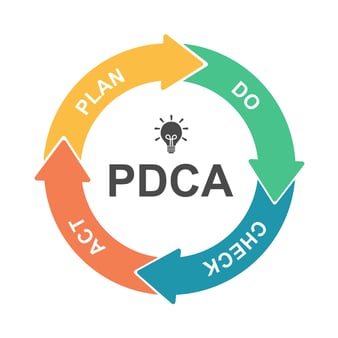 AI Changes the Tempo of PDCA
AI can dramatically accelerate Plan-Do-Check-Act.
Imagine a problem-solving team analyzing years of quality records, maintenance history, supplier information, process parameters and previous corrective actions in minutes instead of days.
AI can help develop better hypotheses faster.
But someone still has to go to Gemba, understand what is actually happening, test the hypothesis, and determine whether the countermeasure worked.
AI doesn’t replace PDCA. It changes its tempo.
That may ultimately be AI’s greatest contribution to Lean.
For decades we’ve focused on reducing production lead time. Perhaps we should now focus on another measure:
Learning lead time.
How quickly can we move from:
Problem → Observation → Insight → Experiment → Learning → Improvement?
 The organizations that win with AI won’t necessarily be those that use the most AI. They’ll be those that combine clear direction, Lean discipline, trustworthy frontline information, and human judgment with AI’s analytical speed.
Lean builds the discipline. AI changes the tempo.
And before AI can think like your best people, it first has to see what they see.






Comment