
AI has changed how software gets built.
Today, you can describe an application in plain language and have an AI tool generate working code, interfaces, and workflows in minutes. This approach is often called “vibe coding.”
It’s fast. It’s accessible. And for many teams, it feels like a breakthrough.
But there’s a gap between building something quickly and building something that actually works in real-world operations. Learn why AI generated apps can fail in real-world operations.
 What Is Vibe Coding?
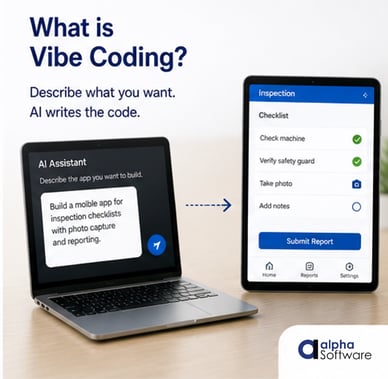
Vibe coding is the process of building applications using natural language prompts, where AI tools generate code, workflows, and user interfaces based on user input.
Instead of writing code manually, users tell AI what they want:
- “Create an inspection app.”
- “Build a process for creating service tickets.”
- “Turn this data into a dashboard."
AI interprets the request and generates a working application or prototype. Vibe coding dramatically lowers the barrier to entry for app development, enabling anyone to create applications quickly, even those workers without a background in development.
Why Vibe Coding Is Getting More Popular
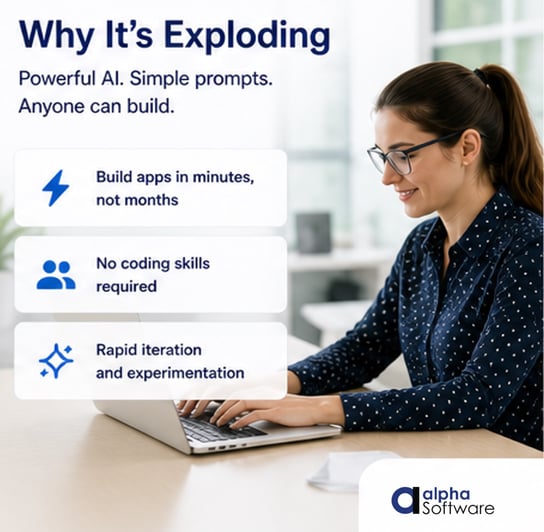 Vibe coding use is expanding because it remotes of common bottlenecks and obstacles common with software development.
With vibe coding, people can:
- Prototype ideas faster
- Build internal productivity tools without hiring engineers
- Try out different workflows and digital ideas
- Create disposable apps
- Iterate quickly
Stack Overflow polls indicate that most developers are now using AI technologies in their daily work. The vibe coding trend is here and accelerating.
Where Vibe Coding Is Useful
Vibe coding is especially effective for:
-
Rapid Prototyping - Testing ideas quickly before committing to full development.
-
Internal Tools - Crafting simple dashboards or lightweight workflows.
-
Early-Stage Exploration - Understanding how a procedure might work digitally.
-
Personal Productivity Apps - Automating small, individual tasks.
In these situations, speed is often more important than long-term dependability of the app.
 Where Vibe Coding Breaks Down
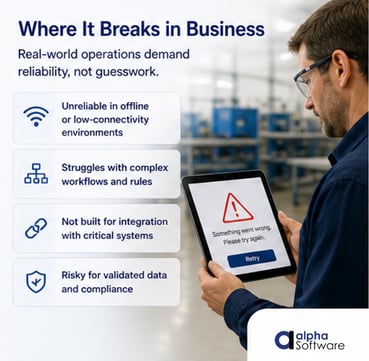
The limitations become clear when apps move into real-world business operations.
1. No Offline Capability
Most AI-generated apps assume constant connectivity, but this isn't true in many real-world environments.
Field teams, manufacturing floor workers, and remote operations staff often work without reliable internet access. When apps require connectivity, workflows can break if the apps can't work offline.
2. Limited Data Validation
AI can generate forms but doesn’t instruct or enforce how employees collect information. This can cause:
- absent data
- data that doesn't match up
- incorrect records
Gartner estimates that poor data quality costs organizations an average of $12.9 million per year.
3. Workflows that Break
Vibe-coded apps don't always ensure that processes are consistent.
That means:
- steps are missed
- users improvise
- results vary
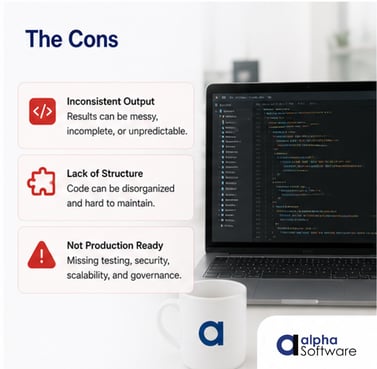 In operational environments, particularly those with compliance and audit requirements, this is a serious risk.
4. Poor Integration
AI can plug into APIs, but production systems require:
- structured data
- reliable synchronization
- error handling
Without that, integrations break over time.
5. Limited Support for Audits or Compliance
Proof of work is required in several fields:
- timestamps
- recordings
- trusted data validation
Vibe-coded apps don't usually come with these features.
6. Difficult to Maintain Over Time
Building the first version of an application is only part of the challenge. Business applications rarely stay the same. New requirements emerge. Processes change. Systems get upgraded. Someone asks for a new field, report, workflow, or integration.
Vibe coding can make it easy to generate an application quickly, but maintaining that application months later can be a different story. The person who created it may no longer be involved, the original prompts may be forgotten, and understanding how the application works can become difficult for the next person responsible for supporting it. This may not be a concern for prototypes or simple tools, but for systems that support day-to-day business activities, long-term maintainability is as crucial as the speed of creation.
7. Doesn't Identify the Real Operational Problem
One of the biggest misconceptions about vibe coding is that building software is the hardest part. In reality, the hardest part of developing valuable applications is identifying the proper problem to address.
AI can create displays, workflows and code, but it can’t traverse a manufacturing facility, see how work is actually done, or find the operational bottlenecks that cause delays, quality concerns, inventory problems or compliance hazards. For example, a company may believe it needs a better reporting application when the real issue is inconsistent data collection on the shop floor. Another may think it has an inventory problem when a receiving process isn't consistently followed.
While AI can help build a solution, it still takes humans to determine what problem is worth solving in the first place.
The Real Difference is Speed vs. Reliability
Vibe coding is all about speed. Meanwhile, business systems require reliability and high trust in the data.
That means:
- consistent workflows
- verified data
- compatibility with existing systems
- performance under real-world conditions
This is where many AI-created apps fall short.
How Vibe Coding Fits into AI App Development
Vibe coding is not the problem.
It’s part of the solution.
The best approach is to use vibe coding for:
- ideation
- prototyping
- early workflow design
Then transition to systems designed for real-world execution.
If you're exploring how to build applications using AI, it's crucial to know what it takes to design business systems that operate reliably in real-world situations and solve the most important operational problems. Learn more about AI app development that works in real-world operations.
 What is a Better Fit for Coding Business Apps?
This is where Alpha Software comes in.
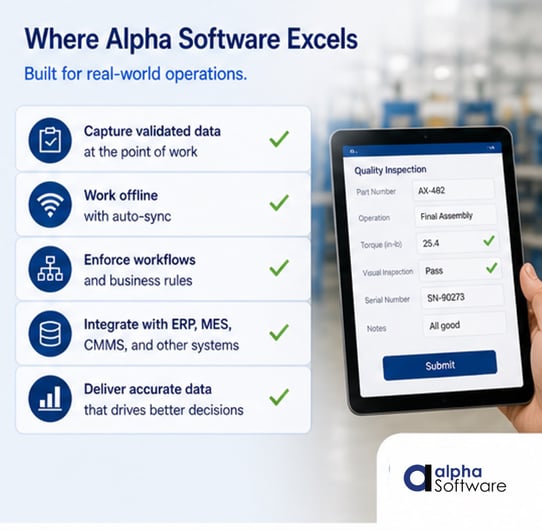
Using Alpha TransForm, organizations can take ideas generated through AI and turn them into production-ready systems.
That includes:
- validated data capture at the point of work
- offline capability
- structured workflows
- integration with ERP and backend systems
Instead of stopping at a prototype, Alpha Software helps deliver systems that operate reliably in real-world environments.
Using Vibe Coding Effectively
Vibe coding is changing how companies build applications, and there are situations where it can dramatically accelerate development, but generating an application is only part of the challenge.
Successful business applications require more than code. They require an understanding of the operational problem being solved, confidence that the application can be maintained as requirements change, and the ability to support real-world workflows, data collection, and system integration.
The organizations that get the most value from vibe coding will use AI to accelerate development while relying on people, process knowledge, and operational expertise to turn those applications into solutions that actually work.
Build for Real-world Business Scenarios
If you're exploring vibe coding or AI-generated apps but need something that actually works in your operation, book a meeting with Alpha Software and we’ll help you turn your idea into a production-ready solution.
Further reading: Learn why data quality is the Achilles heel of AI.








Comment