
Your ERP may be working perfectly. But if the data coming from your shop floor is incomplete, inaccurate, or delayed, how much is that costing your business?
 Every manufacturer tracks costs like materials, labor, equipment, and overhead. But there’s another expense that rarely appears as a separate line item: the cost of unreliable operational data.
Think about what happens when a quality inspection is incomplete, a production count is entered incorrectly, or a maintenance issue isn’t recorded until the end of a shift.
Someone has to investigate. Records need to be checked. Production may be delayed. Sometimes work has to be repeated.
These costs are real, but they’re often scattered across departments, making them difficult to identify.
The American Society for Quality (ASQ) recognizes scrap, rework, and other failures as part of the cost of poor quality. Yet manufacturers may also incur additional costs simply trying to find, verify, and correct information before they can use it.
Here are five hidden costs of bad manufacturing data, along with a practical way to estimate what they’re costing your operation.
1. The Cost of Finding and Correcting Bad Data
How much time does your team spend looking for information that should already be available?
A quality manager searches for a missing inspection record. A supervisor calls an operator to clarify a production number. Someone in accounting asks why the inventory count doesn’t match the ERP.
Each incident may seem minor, but the hours accumulate.
And the cost isn’t limited to the employee correcting the information. It can involve supervisors, quality managers, IT personnel, and other employees who should be focused on higher-value work.
How to calculate it:
Monthly correction cost = Number of data issues per month × Average time to resolve each issue × Fully loaded hourly labor rate
Multiply the result by 12 for an annual estimate.
For example, suppose your operation experiences:
- 80 data discrepancies per month
- 30 minutes of combined employee time to resolve each discrepancy
- $45 per hour in fully loaded labor costs for the frontline and supervisory staff involved
Your estimated cost would be:
80 × 0.5 hours × $45 = $1,800 per month
That’s $21,600 annually, just for resolving data discrepancies.
And it doesn’t include the cost of decisions delayed while employees investigate.
2. The Cost of Scrap, Rework, and Quality Escapes
Bad manufacturing data can become especially expensive when it affects product quality.
Consider a measurement recorded incorrectly during an inspection. If the error isn’t caught, production may continue under the assumption that everything is within specification.
By the time the problem is discovered, additional units may require inspection, rework, or disposal.
The problem isn’t always that the original work was performed incorrectly. Sometimes the information needed to identify or contain a problem wasn’t captured accurately or quickly enough.
How to calculate it:
Start by identifying scrap and rework incidents where missing, inaccurate, or delayed information contributed to the outcome.
Annual data-related quality cost = Number of attributable incidents × Average incremental cost per incident
For example:
- 12 incidents annually
- $2,000 in average additional scrap, rework, inspection, and labor costs per incident
12 × $2,000 = $24,000 annually
Be careful not to attribute every quality failure to bad data. The objective is to identify the portion that better data capture or validation could realistically prevent.
3. The Cost of Production Delays, Downtime, and Waiting
 When production data is unreliable, managers may not know there’s a problem until it has already affected output.
An equipment issue isn’t recorded promptly. A material shortage isn’t reported accurately. A failed inspection doesn’t reach the right person quickly enough.
These gaps can delay corrective action and extend production interruptions.
Even when the underlying problem couldn’t have been prevented, faster and more accurate information may help the organization respond sooner.
Timeliness matters even when nothing is wrong.
Delays aren’t always caused by problems that go unnoticed. Sometimes the line is simply waiting for confirmation that everything is OK to proceed.
Take First Piece Inspection. When it’s done on paper, there can be a gap between the operator completing the form and a QC technician reviewing and signing off. During that time, the operator, and sometimes the entire line, may sit idle.
Digital inspection workflows can shorten that wait by routing results to the right person immediately and capturing approval as soon as it’s given. The same applies to other sign-offs and checkpoints that gate production.
How to calculate it:
Estimate the additional downtime and idle time caused specifically by delayed, missing, or incorrect information, including time spent waiting for approvals.
Annual data-related downtime cost = Attributable downtime hours × Financial cost per downtime hour
For example:
- 2 additional hours of downtime or idle waiting per month attributable to information delays
- $1,500 per hour in incremental downtime costs
(2 hours × 12 months) × $1,500 = $36,000 annually
Use a downtime rate approved by your finance team. It should reflect the actual financial impact, such as overtime, expediting, lost contribution margin when production cannot be recovered, or other incremental expenses.
Avoid counting the same lost production twice.
4. The Cost of Inventory and ERP Discrepancies
Manufacturers invest heavily in ERP systems because they need accurate information about inventory, purchasing, production, and financial performance.
But even the most sophisticated ERP can’t independently verify every activity happening on the shop floor.
If receiving quantities are entered incorrectly, material movements aren’t recorded, or production counts are submitted late, the ERP may contain information that doesn’t match physical operations.
The result can be cycle-count investigations, unnecessary purchases, production scheduling problems, and expedited shipments.
How to calculate it:
Identify the incremental costs of resolving discrepancies caused by inaccurate operational data.
Annual discrepancy cost = Reconciliation labor + Incremental expediting costs + Other verified discrepancy-related expenses
For example:
- 10 hours per month of inventory and materials staff time reconciling data discrepancies, at $50 per hour
- $500 per month in avoidable expediting costs
(10 × $50 × 12) + ($500 × 12) = $12,000 annually
Don’t automatically count the full value of an inventory discrepancy as a loss. First determine whether it represents missing inventory, a timing issue, or an inaccurate record.
The goal is to calculate the actual business cost of the data problem.
5. The Cost of Management Time and Delayed Decisions
Some of the most expensive consequences of bad data don’t appear in quality or production reports.
They show up in meetings.
A plant manager questions the production numbers. A quality director asks for a second report. An operations executive waits for someone to reconcile conflicting spreadsheets before making a decision.
When leaders don’t trust the information they’re receiving, they spend time validating it.
That creates a hidden management burden and can slow improvement initiatives.
It can also undermine investments in analytics and AI, which depend on reliable underlying information.
How to calculate it:
Annual management verification cost = Hours spent verifying or reconciling unreliable data per week × Fully loaded hourly rate × Working weeks per year
For example:
- 3 hours per week
- $100 per hour in fully loaded management costs
- 50 working weeks
3 × $100 × 50 = $15,000 annually
This is a labor-capacity estimate, not necessarily a cash saving. The financial value of recovering those hours depends on how that time is redeployed.
Add It Up: What Could Bad Manufacturing Data Be Costing You?
Here’s how the five examples compare for a hypothetical manufacturing operation. Because some of these costs are direct expenses and others represent employee time that could be redirected, we’ve separated them into two columns.
| Hidden cost | Hard-dollar cost | Recoverable labor capacity |
|---|---|---|
| Finding and correcting data | — | $21,600 |
| Scrap, rework, and quality issues | $24,000 | — |
| Production delays, downtime, and waiting | $36,000 | — |
| Inventory and ERP discrepancies | $6,000 | $6,000 |
| Management verification time | — | $15,000 |
| Subtotal | $66,000 | $42,600 |
| Total estimated annual impact | $108,600 |
These are illustrative calculations, not industry averages or documented customer results. The example assumes each category reflects separate activities and employee hours, with no overlap between them.
The actual cost at your facility could be significantly higher or lower.
The important point is that poor operational data creates expenses across multiple departments, making the total cost easy to underestimate.
How to Calculate Your Own Cost of Bad Manufacturing Data
You don’t need a lengthy consulting engagement to get started.
 Choose one production line, department, or facility and examine a recent 30-day period.
Step 1: Identify recurring data problems
Look for missing inspection records, inaccurate production counts, inventory discrepancies, delayed maintenance reports, slow inspection sign-offs, and information that employees regularly have to verify.
Step 2: Measure the time and money involved
For each type of problem, record how frequently it occurs, who gets involved, how long resolution takes, and whether it causes additional costs such as scrap, overtime, idle time, or downtime.
Step 3: Calculate the monthly impact
Use the formulas above to estimate the cost of each category.
Include only costs reasonably attributable to data problems. Separate hard-dollar expenses from labor capacity that could be recovered.
Step 4: Check for double counting
A single incident may cause downtime, rework, and management investigation time.
Those can be distinct costs, but the same employee hours or production losses shouldn’t be counted in multiple categories.
Step 5: Identify one high-value improvement
Find the process responsible for the most frequent or expensive data problems.
That might be quality inspections, production reporting, receiving, equipment maintenance, or final product verification.
Then estimate how much of the cost could realistically be reduced by improving data capture.
This gives you a practical starting point for calculating potential return on investment.
The Real Solution: Fix Bad Data at the Point of Work
 Many manufacturers respond to data quality problems by investing in better reporting, dashboards, or ERP upgrades.
Those investments can be valuable. But if the information entering the system is inaccurate, reporting improvements alone won’t solve the underlying problem.
The most effective place to prevent many operational data errors is where the information is originally captured.
That’s where Alpha Software helps.
Using Alpha TransForm and Alpha Anywhere, manufacturers can build mobile-first operational workflows that make it easier for frontline employees to capture accurate, complete information while performing their work.
Depending on the application, these workflows can:
- Require critical information before a record is submitted.
- Validate measurements, quantities, and other entries against business rules.
- Guide employees through inspections and standard operating procedures.
- Route inspection results and approvals to the right person immediately.
- Capture photos, timestamps, signatures, and other supporting information.
- Work in environments with unreliable connectivity.
- Connect captured information to ERP systems, databases, and other business applications.
Designed for the people doing the work
 Just as important, these applications are built with frontline workers in mind.
Most ERP and back-office systems are designed for office users, accountants, and planners. For people on the shop floor, they can be a real chore to use, with far more screens and functions than anyone on the line needs.
Alpha Software applications take a different approach. Interfaces are intuitive and unobtrusive, showing workers only what they need for the task in front of them. The goal is to capture accurate data without slowing down the work.
That focus on the worker is what drives adoption. And adoption matters: even the best data capture system can’t improve data quality if employees avoid using it.
Instead of asking employees to correct bad information later, manufacturers can reduce errors and omissions at the source.
And they can do it without replacing their existing ERP.
What Does Better Operational Data Look Like in Practice?
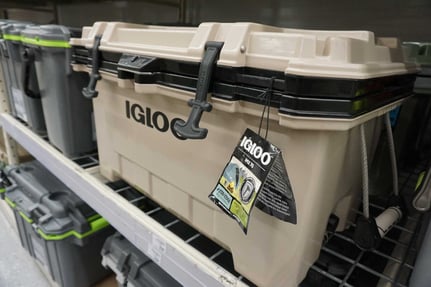 At Igloo Products, quality inspection information was historically recorded on paper across a large manufacturing operation.
Finding a specific inspection record could require searching through boxes of documents.
By digitizing its quality data collection processes with Alpha Software, Igloo made inspection information easier to capture, retrieve, and analyze. Digital workflows also helped speed up inspection sign-offs, reducing the time production spent waiting for approval to proceed.
The company reported $145,000 in cost savings and achieved paperless inspection workflows.
The broader lesson is that improving operational data capture can reduce administrative effort, keep production moving, and make information more useful to quality and operations teams.
Before You Invest in Another System, Find Out What Bad Data Is Already Costing You
If your employees regularly question ERP reports, search for missing records, wait on paper sign-offs, reconcile spreadsheets, or correct information after the fact, your organization may be paying a hidden cost for unreliable operational data.
And those costs may be spread across enough departments that no one sees the full picture.
Start by calculating the impact of one problematic workflow.
You may discover that improving how information is captured at the point of work offers a faster, more practical return than another major technology initiative.
 Want to identify where bad data is costing your operation?
Alpha Software can help you examine an existing inspection, production, or operational workflow and explore ways to improve data accuracy without replacing your ERP.







Comment