
Download free HVAC preventive maintenance checklist templates from trusted public sources and learn how to digitize inspections for faster, more reliable results.

Key Takeaways
- A structured HVAC preventive maintenance checklist reduces unexpected breakdowns and extends equipment lifespan across commercial and industrial facilities.
- Free, downloadable PDF templates from the U.S. EPA and GSA provide reliable starting points for building your own HVAC maintenance program.
- Seasonal checklists covering cooling systems, heating components, air filters, and electrical connections help teams stay ahead of costly repairs.
- Transitioning from paper checklists to digital mobile apps eliminates lost paperwork, speeds up data collection, and improves accountability.
- We offer a ready-to-use HVAC Inspection Checklist app template built with Alpha TransForm that works offline and captures data instantly on mobile devices.
Why HVAC Preventive Maintenance Can't Be an Afterthought
An HVAC preventive maintenance checklist helps facilities avoid costly breakdowns, reduce energy waste, and maintain safety compliance. Yet, many teams still rely on inconsistent processes or outdated paper forms to manage the work.
Free, proven templates from agencies like the U.S. EPA and GSA give operations leaders a strong starting point, while digital inspection apps eliminate the data gaps and accountability issues that paper-based systems create. According to the U.S. Energy Information Administration (EIA), HVAC systems account for approximately 40% of the energy used in commercial buildings, making poorly maintained HVAC equipment one of the most expensive operational risks a facility can carry.
The following sections detail the essential items for a comprehensive HVAC PM checklist, list trusted sources for free templates, and explain how to upgrade from static PDFs to mobile-first inspections for richer data and faster results.
|
Alpha TransForm: Digital Solutions to Collect, Analyze, and Act on Data Turn Paper Forms Into Mobile Apps in Minutes | No IT Team Required | Works Offline | Trusted by Manufacturing & Field Teams  Why Business Leaders Choose Alpha TransForm: ✓ Built-in custom dashboards and workflows to trigger business activity✓ Seamless integration with existing business systems ✓ Replace Excel with digital data collection and analysis ✓ Rapid digitization—build apps in days without IT bottlenecks ✓ Proven ROI with scalable start-small approach ✓ Trusted by manufacturing, construction, and healthcare leaders From Paper to Digital in 3 Steps 1. Upload your paper form or start from scratch2. Customize fields and logic as needed 3. Deploy to mobile devices and start collecting data instantly Stop losing time with paper processes. Start delivering business value today.
|
What to Include in an HVAC Preventive Maintenance Checklist

A comprehensive HVAC preventive maintenance checklist should cover filters, cooling, heating, electrical connections, and moving parts.
While every facility is different, most HVAC preventive maintenance programs share common inspection items. A comprehensive checklist should cover the major system components that, when neglected, lead to breakdowns, compliance issues, or wasted energy. At a minimum, your checklist should address the following areas:
Air filters and ventilation — Inspect and replace or clean air filters regularly (typically every 30 to 90 days). Clogged filters force the system to work harder, increasing energy consumption and reducing air quality. Check that outdoor air dampers are functioning properly and that airflow is unobstructed.
Cooling system components — Clean condenser and evaporator coils, check refrigerant levels, inspect the condensate drain line for clogs, and verify that the compressor is operating within normal parameters. These tasks are especially important before the peak summer months.
Heating system components — Inspect burner assemblies, heat exchangers, and flue connections. Check for carbon monoxide or gas leaks around heating elements and test ignition systems. These checks should be completed before cold weather sets in.
Electrical connections and controls — Tighten all electrical connections, inspect wiring for signs of wear or corrosion, verify thermostat calibration, and test safety controls. Regulatory agencies like OSHA require that electrical connections be properly insulated and grounded during servicing, and this step also supports that requirement.
Belts, bearings, and moving parts — Check belt tension and alignment, lubricate motor bearings, and inspect fan blades for damage or excessive dirt buildup. Worn belts and dry bearings are among the most common causes of HVAC motor failure.
Free HVAC Preventive Maintenance Checklist Templates
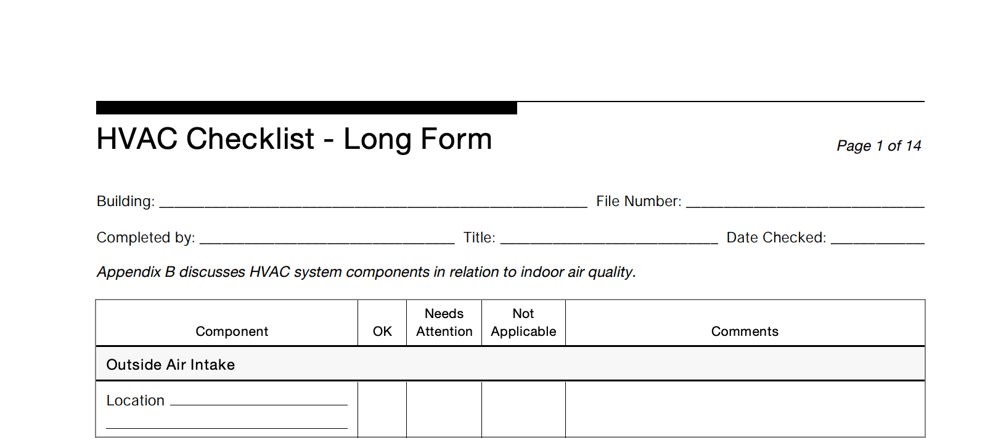
The EPA offers free short and long form HVAC checklists to help facility managers conduct routine and detailed inspections.
Several government agencies and public institutions publish HVAC maintenance templates for free download and use. These templates are reliable starting points because they reflect established building management and indoor air quality standards. Below are two of the most widely used options.
EPA HVAC Checklist — Short Form
The U.S. Environmental Protection Agency publishes a Short Form HVAC Checklist (PDF) as part of its Building Air Quality Guide. This four-page template offers facility managers a practical overview of HVAC system health. It covers mechanical room conditions, the status of major equipment (boilers, cooling towers, chillers), ventilation adequacy, and filtration. The form includes fields for recording building information, inspector details, and follow-up notes, making it a solid tool for routine walkthroughs.
EPA HVAC Checklist — Long Form
For more detailed inspections, the EPA also offers a Long Form HVAC Checklist (PDF), spanning 14 pages with granular checkpoints. This template examines areas such as outdoor air intake conditions, mixed-air temperature controls, spray humidifiers, ductwork integrity, and exhaust systems. It is especially useful for commercial buildings that need to document compliance with indoor air quality standards such as ASHRAE Standard 62.1. The document is in the public domain, so teams can reproduce and adapt it freely.
GSA Preventive Maintenance Guide Cards
The U.S. General Services Administration (GSA) maintains a comprehensive set of Preventive Maintenance Guide Cards (PDF) that cover HVAC equipment, including self-contained heating/cooling units, chillers, air handling units, and cooling towers. Each guide card outlines specific inspection steps, safety procedures (including lockout/tagout requirements), and refrigerant management protocols. Because these are more technical than the EPA checklists, they work best for operations teams with dedicated maintenance staff.
The Problem With Paper-Based HVAC Checklists
PDF checklists are a good starting point, but they come with real limitations when used on the ground. Paper forms get lost, damaged, or filled out inconsistently. Handwritten entries are hard to read, difficult to analyze, and nearly impossible to search through later. When a facility manager needs to verify that a specific unit was inspected last quarter, digging through filing cabinets is slow and unreliable.
Paper processes also create accountability gaps. There is no easy way to confirm who completed an inspection, when it was done, or whether follow-up actions were actually taken. For organizations managing multiple sites or large equipment inventories, these gaps add up quickly and create risk during audits or regulatory reviews. The shift from static PDF templates to digital, mobile-first inspection tools is one of the most practical upgrades a maintenance team can make.
Going Digital: HVAC Checklist Apps That Work in the Field
Digital checklists solve the core problems that paper creates. Inspectors can complete HVAC maintenance checks on a smartphone or tablet, capture photos of equipment issues, automatically attach timestamps and GPS data, and sync completed inspections to a central dashboard even from locations with limited connectivity.
We provide an HVAC Inspection Checklist app template built with Alpha TransForm, designed for exactly this kind of field work. The app supports barcode scanning to quickly pull up equipment records, performs real-time calculations and data validation, and works offline — a critical feature for maintenance teams operating in basements, mechanical rooms, rooftops, or remote facilities where cell signal is unreliable.
For teams that also perform broader facility inspections, our Equipment Inspection Checklist template provides a flexible framework for checking equipment-specific items with pass/fail indicators, elapsed time tracking, and one-handed data entry optimized for mobile use.
Why Choose Alpha TransForm for HVAC Maintenance Digitization

Alpha TransForm by Alpha Software helps HVAC teams digitize paper checklists into offline-ready mobile apps in minutes — no coding or IT required.
Transitioning from paper checklists to digital mobile apps eliminates lost paperwork and improves technician accountability. Business leaders use Alpha TransForm to convert static PDF forms into functional inspection tools in minutes. This no-code platform removes technical barriers so operations teams can modernize their maintenance programs immediately.
From Paper to Digital in 3 Steps:
- Upload your paper HVAC checklist or start from our ready-made template.
- Customize fields, logic, and alerts to match your maintenance program.
- Deploy to mobile devices and start collecting data instantly.
These mobile apps function reliably in mechanical rooms or rooftops where internet access is often unavailable. Technicians capture photos, signatures, and barcode data that sync automatically with existing business systems for real-time reporting. Request a consultation to see how Alpha TransForm streamlines equipment inspections and reduces operational risks.
FAQs
How often should HVAC preventive maintenance be performed?
What is the difference between the EPA short form and long form HVAC checklists?
Can HVAC maintenance checklists help with regulatory compliance?
What are the risks of skipping HVAC preventive maintenance?
How does Alpha TransForm improve HVAC maintenance workflows?
*Note: Alpha TransForm is a no-code app builder developed by Alpha Software. Product features, availability, pricing, and results referenced are for informational purposes only and subject to change; actual capabilities and outcomes may vary based on configuration and use case. To confirm current offerings and pricing, talk to a Solutions Consultant.






Comment