
This week I attended an executive summit run by Babson College in the Boston area, sitting across from leaders in pharma, tech, construction, and manufacturing. The conversations ranged widely, but one topic kept surfacing, sometimes cautiously, sometimes with real urgency:
What is the risk of Shadow AI in the enterprise?
- Shadow AI creates significant risks of proprietary data leakage and "hallucinations"—where AI generates confident but entirely false information.
- Managing these risks requires a governed workflow that provides employees with sanctioned, secure AI tools to discourage the use of unvetted, personal accounts.
Shadow AI.
Some companies had locked AI down completely. Others were actively encouraging experimentation. Several executives admitted they knew it was happening and had no clear plan for what to do about it. As I listened, I kept having the same feeling: We’re watching the same pattern play out again; this time, it’s faster, harder to detect, and far riskier.
What is Shadow AI?
Shadow AI is the unsanctioned use of artificial intelligence tools and Large Language Models (LLMs) by employees without the explicit knowledge or approval of the IT department. Much like "Shadow IT" or "Shadow Analytics," Shadow AI is driven by employees' need for speed and productivity that outpaces official corporate security policy.
Common Examples of Shadow AI in the Workplace |
|
| Communication & Meetings | AI Meeting Assistants: Unsanctioned bots that join Zoom/Teams calls to record and transcribe without IT-vetted data retention policies. AI Chatbots/Personal Assistants: Employees using personal accounts for ChatGPT, Claude, or Gemini to draft sensitive internal emails or memos. |
| Content & Creative | Unsanctioned Image/Video Generators: Using tools like Midjourney or Sora for marketing assets, potentially violating copyright or brand guidelines. AI Browser Extensions: Tools that summarize web pages or autocomplete text in the browser, often reading everything on the screen. |
| Technical & Development | AI Coding Assistants: Developers using unapproved plugins (like personal GitHub Copilot accounts) that may leak proprietary source code into public training sets. AI App Builders: Non-technical staff building quick internal apps or automations using unsanctioned AI app builders. |
| Embedded "Hidden" AI | Stealth SaaS Features: AI features that were recently added to your existing software (like a CRM or Project Management tool) that haven't been reviewed for compliance. Autonomous AI Agents: Small scripts or "bots" created by employees to fetch data and perform tasks across different systems without oversight. |
Before my work in enterprise software, I spent years in the data analytics world, back when SAS and Cognos were the gatekeepers of business intelligence, and getting an answer to a business question meant going through IT. What's unfolding with AI today is a similar pattern I watched play out then. It's just faster, easier, and has considerably higher stakes.
Shadow Analytics: A Precursor to the Shadow AI Trend
In the pre-self-service analytics era, getting a business question answered was a process. You submitted a query to IT, waited for a report, came back with a follow-up question, and waited again. For teams in sales, marketing, or finance, where decisions moved faster than IT queues, that model became unworkable.
So managers found a workaround: they exported data into Microsoft Excel and did the analysis themselves. What started as individual productivity hacks quietly became organizational practice. Critical data left governed systems. Spreadsheets got emailed, duplicated, and modified. Version control disappeared. Data visualization tools offered free trials to upload your file and get your data questions answered. "Shadow analytics" became the norm, not because people were careless, but because the official path couldn't keep up with how work actually happens.
IT didn't lose control of the data because of bad intentions. They lost control because friction often loses to urgency.
Shadow AI is Spreading Faster Than Shadow IT
Some companies are attempting to manage AI the way they once tried to manage analytics: lock it down, restrict access, route everything through approved channels. And the same forces that defeated those controls are at work again: pressure for faster decisions, frustration with slow approvals, and excitement around tools that can answer questions instantly.
The Hidden SaaS Upgrade:
Many employees don't even realize they are using Shadow AI. It happens when a tool they already use, such as a CRM system, suddenly pushes an 'AI Assistant' update that hasn't been vetted by your security team.
"The 'Hidden' SaaS Upgrade: Many employees don't even realize they are using Shadow AI. It happens when a tool they already use—like a CRM or Project Manager—suddenly pushes an 'AI Assistant' update that hasn't been vetted by your security team."
So people route around the system. The pattern is virtually identical. Only the technology has changed.
The Meeting You Didn't Govern
 During one AI session run by Professor Sebastian Fixson, Faculty Director/DBA Program at Babson College, we had a great discussion around this subject and related topics.
One scenario I raised at the conference generated a strong reaction, likely because it's both entirely plausible and almost universally overlooked:
Imagine a pharmaceutical company with genuinely tight controls on its customer data: CRM access restricted, data warehouses secured, compliance processes in place. Now imagine a senior account rep joining a customer call on Zoom or Teams. They activate an AI note-taker. Or an AI transcription tool.
The customer hears, "This Zoom call may be recorded." But they're not necessarily thinking about what that actually means in 2026. An AI system is transcribing the conversation in real time. It's extracting insights. It's storing the results somewhere outside the systems your IT and compliance teams have any visibility into. And if the conversation touched on product roadmaps, future plans, or anything covered by an NDA, that information is now sitting in a third-party system that nobody in your organization approved. Likely, the notes or insights are being sent around and forwarded as follow-up materials.
No one in IT signed off on it. No one in compliance reviewed the vendor's data retention policy. It happened because it was easy, it was useful, and nothing stopped it. I’ve sat in these meetings. The convenience of a perfect transcript is addictive, but as an executive the thought of an NDA-protected roadmap training a public model keeps me up at night.
The Spreadsheet-to-AI Pipeline
 The second scenario is more familiar because it's just the Excel story with a new ending.
A company restricts AI usage. An employee still needs answers, faces a deadline, and has a problem that AI could solve in minutes. So they export the relevant data as a CSV, an Excel file, or a PDF and move it to a personal device, then upload it to ChatGPT or another AI tool. Insights are generated. Problems are solved. Nobody else knows it happened.
This scenario is the modern version of exporting sensitive corporate data into a spreadsheet, but the risk profile is fundamentally different. The data doesn't just leave your network, it's uploaded to an external system, processed by a third-party model, potentially retained depending on account settings, and generates outputs that may be confidently wrong in ways that are hard to detect. I'd call this shadow data movement, and it may be a bigger problem than shadow AI itself, precisely because it's invisible until something goes wrong.
This isn't just a security gap; it's a 'Shadow Data' movement. We're seeing employees treat public AI boxes like a private calculator, yet it’s anything but.
The Two Unique Risks of Shadow AI (vs. Shadow Analytics)
 The Excel era created real problems: data duplication, version chaos, decisions made on stale numbers. Those were costly. But AI introduces two risk layers that shadow analytics never had.
The first is exposure at scale. When someone exported data into a spreadsheet, it left the building in one file. When someone uploads data to a consumer AI tool, it's processed by infrastructure your organization doesn't control, under terms of service most employees have never read, with data retention policies that vary widely. The exposure isn't just a copy, it's a copy that may persist, be referenced, or in some configurations inform model behavior.
The second risk is subtler and potentially more dangerous: AI doesn't just store data, it interprets it. Shadow analytics gave you bad numbers, and you could usually find the error.
Shadow AI gives you fluent, confident answers that look right, even when they’re wrong.
That’s a very different kind of risk. It doesn’t just create errors. It creates misguided decisions at scale.
| Feature | Shadow Analytics (Excel Era) | Shadow AI (LLM Era) |
| Primary Tool | Spreadsheets/Desktop BI | Public LLMs/AI Note-takers |
| Data Risk | Data duplication & versioning | Model training & public exposure |
| Accuracy | Formula errors (easier to spot) | Hallucinations (hard to detect) |
| Scale | Individual/Local files | Cloud-based/Persistent storage |
The Real Problem Isn't the Technology
 After a week of these conversations in meetings, I kept arriving at the same conclusion: this isn't a technology problem. It's a workflow problem.
Employees aren't trying to undermine security protocols. They're trying to do their jobs, hit their numbers, and keep up with expectations that have accelerated faster than the systems meant to support them. When the official path is too slow or too restrictive, they create their own. They always have. The tools change; the behavior doesn't.
The companies that navigate this well won't be the ones that ban AI, or ignore it, or throw an acceptable use policy at the wall and hope it sticks. They'll be the ones willing to ask a harder question: how do we give people the speed and flexibility they need without losing visibility and control over our data?
That probably means rethinking how data is accessed in real workflows, not just in controlled systems. It means recognizing that "point-of-work" data—what gets said on calls, what gets pulled in the field, what gets discussed in meetings—is where the actual risk lives. And it means building or adopting governed paths to AI-powered insight that are fast enough to compete with the unsanctioned alternatives.
The more interesting strategic question is whether enterprise software vendors get ahead of this. Will they build AI governance into their platforms rather than leaving organizations to bolt it on after the fact? Some are starting to. Most aren't there yet.
The winners won’t be the companies that control AI. They’ll be the ones that redesign workflows to safely harness it.
The Pattern Holds
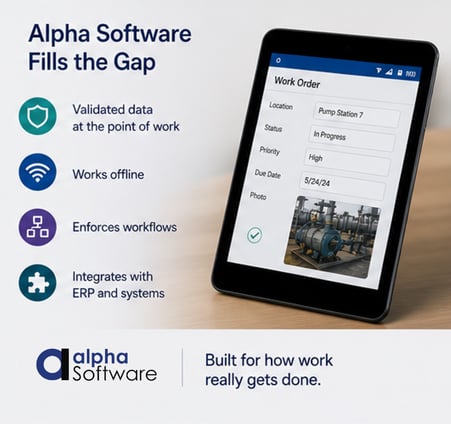 Shadow IT. Shadow analytics. Shadow AI. Each wave followed the same logic: when official systems don't match how people actually work, people change the system, with or without approval.
The difference this time is that it's happening faster, the stakes are higher, and the consequences are harder to detect until they're already consequential. You can lock down your systems perfectly and still lose control of your data in the moments when work actually happens. The risk isn’t in your systems; it’s likely in your workflows.
If you're seeing this happening in your organization, you're not alone. The question was never whether it's happening. The question is whether you can get ahead of it before it becomes invisible.
Ready your organization to benefit from AI
Set up a brief call and we can discuss how Alpha Software’s Governance Layer prevents the Shadow AI risks I just described
Read my related articles:
AI Can Build Apps. But Can It Run Your Business?
The Achilles Heel of AI: Why Most AI Projects Fail (And How to Fix It)
Why AI-Generated Apps Fail in Real-World Operations
------------------------------
Written from experience in enterprise analytics and enterprise software. Views are my own.









Comment